

AI in September 2026: 10 Developments That Defined the Month
Vol. 1Month in ReviewCovering September 2026
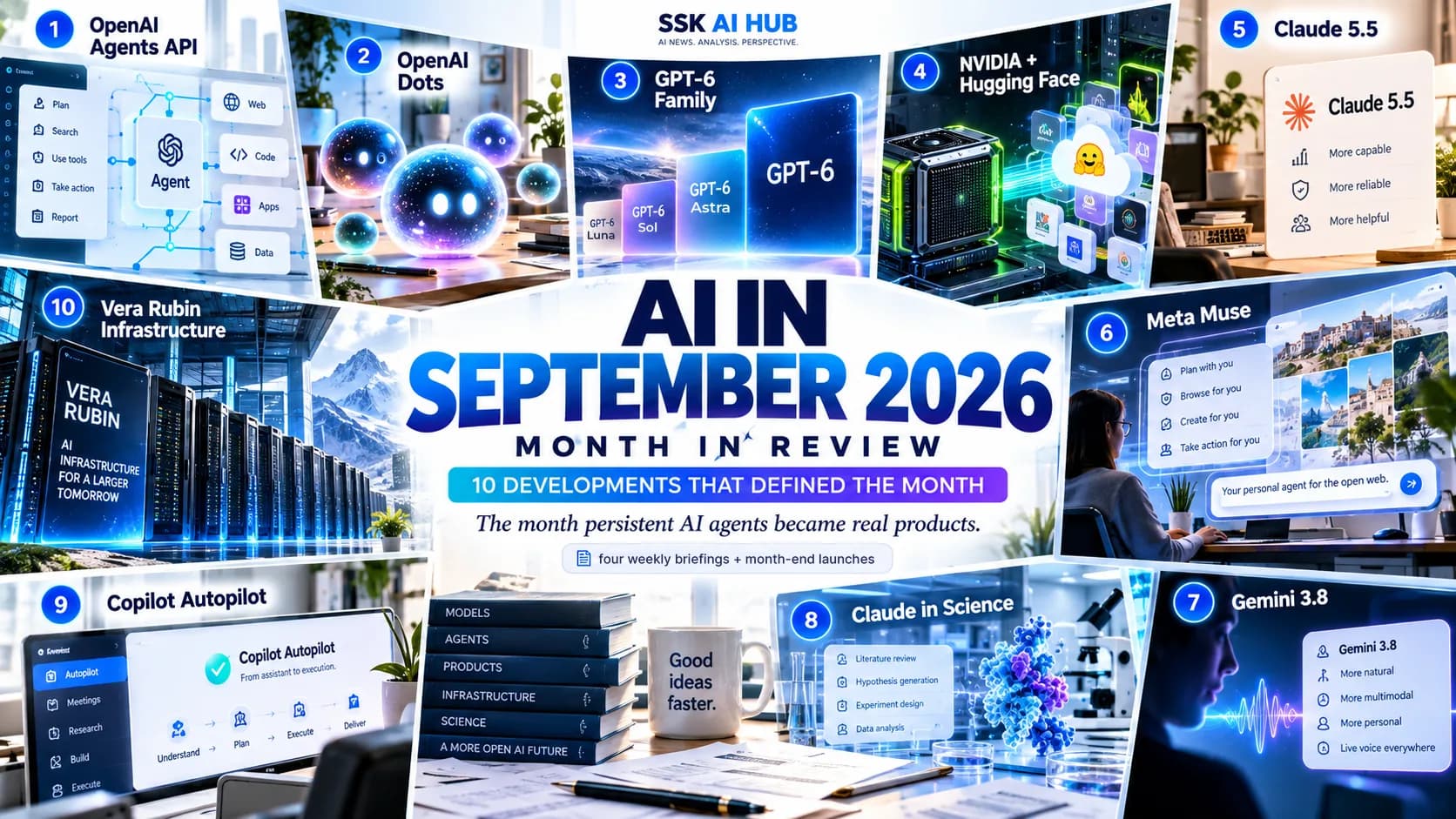
September was the month persistent AI agents became real products — and the system around the model became the product.
- 4weekly editions
- 41stories reported
- 10developments selected
September did not have one defining AI story. It had a defining direction. Across OpenAI, Anthropic, Google, Meta, Microsoft, NVIDIA and the open-model ecosystem, AI moved beyond prompt-and-response systems toward software that can plan, use tools, remember context, operate computers, delegate work and keep running.
Four weekly SSK AI Hub briefings reported 41 stories this month, and the month closed with a burst of announcements on September 25–30 that fell after or outside those weekly selections. Here are the ten developments that best explain what actually changed — each in plain language, each linking to its full weekly analysis or, for the late-month releases, to the primary source.
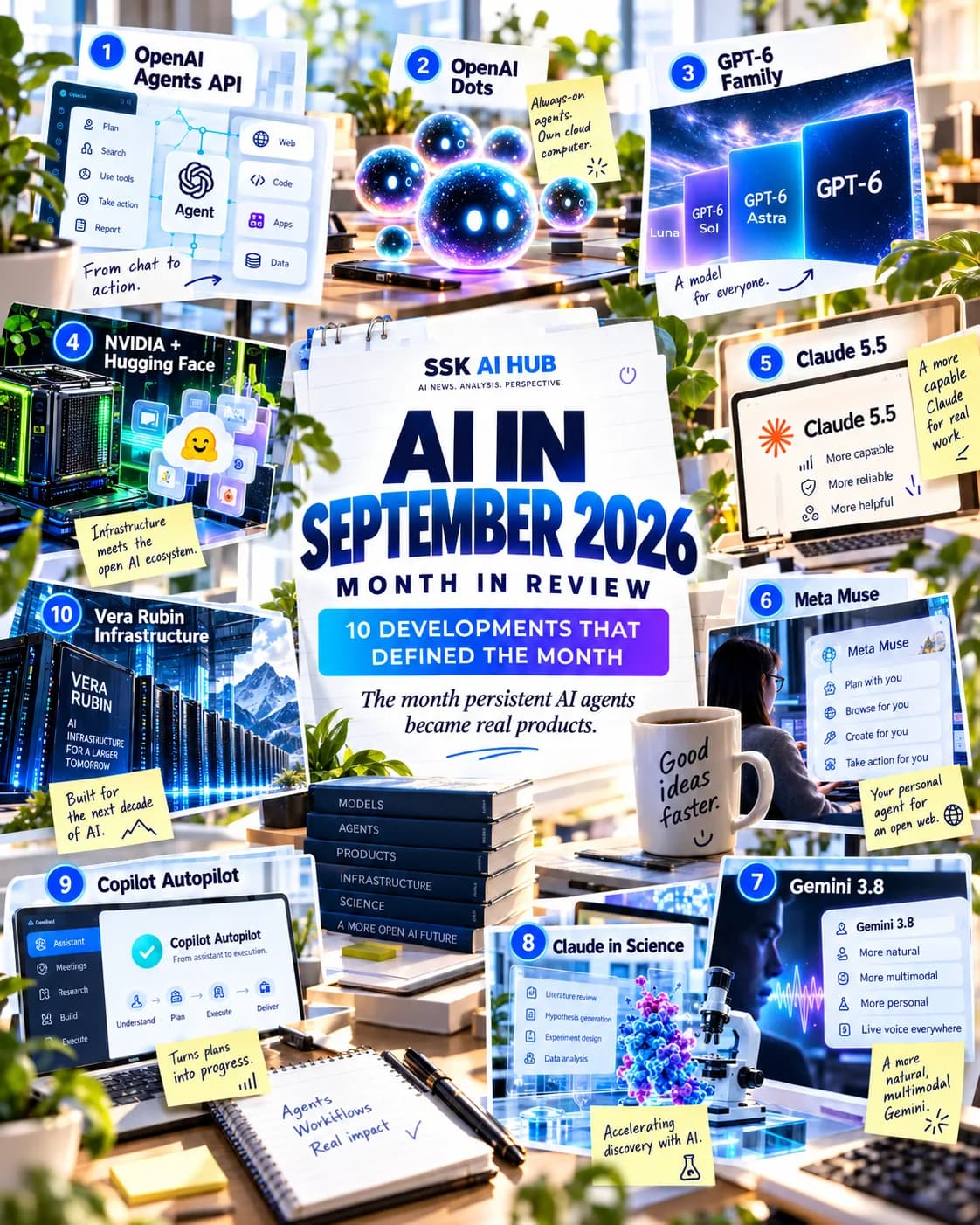
The 10 developments that defined September
OpenAI Agents API
What happened
OpenAI opened its Agents API in public beta: a managed service that handles much of the machinery behind long-running agents — context management, tool search, subagents, and sandboxed execution in OpenAI-hosted or your own environments. At DevDay on September 29, OpenAI added computer use, so agents can operate software directly.
Why it matters
Building a serious agent used to mean stitching together context managers, tool routers, sandboxes, retries and storage by hand. A managed runtime lets teams spend that effort on tools, permissions, evaluation and product behavior instead — though hosted execution carries its own costs.
In simple wordsOpenAI now runs the engine room that keeps an AI agent working, not just the model inside it.
OpenAI Dots
What happened
At DevDay on September 29, OpenAI introduced Dots: always-on agents inside ChatGPT, each running on GPT-6 Astra with its own cloud computer and browser, connecting to apps through OpenAI's plugins and working toward the goals you set. Dots are rolling out first to Pro and Business Premium users in eligible markets.
Why it matters
Dots turn the persistent-agent idea into a concrete product: continuity, connected apps and a place to do the work. That puts the hard questions up front — whose identity the agent acts under, what it may touch, what it remembers, and how a person reviews and stops it.
In simple wordsAn AI helper that keeps working in the background on its own computer, instead of waiting for your next message.
GPT-6 becomes a model family
What happened
September opened with GPT-6 Astra on September 3, rolled out first to a limited set of organizations. GPT-6 Sol and Luna followed on September 22 as faster, lower-cost tiers, and on September 29 OpenAI released GPT-6.1 Sol, a mid-tier upgrade it says approaches Astra-level capability at a much lower cost.
Why it matters
With a frontier model, a balanced model and a high-volume model in one family, the question shifts from 'which model is best?' to 'which model should handle this step?' Sending hard reasoning to the top tier and routine work to cheaper tiers becomes an engineering decision measured in total cost of finishing a task.
In simple wordsOpenAI's newest AI now comes in several sizes, so an app can pick the right one for each job.
NVIDIA agrees to acquire Hugging Face
What happened
On September 3, NVIDIA announced an agreement to acquire Hugging Face for approximately $12.93 billion. NVIDIA said the platform would keep supporting different models, frameworks, clouds and accelerators, and that using NVIDIA compute would not be required. The deal was announced, not closed.
Why it matters
Hugging Face is where much of the open-model world discovers, shares and evaluates models. Bringing it together with the largest AI-compute company ties model distribution to hardware — which could make open models easier to deploy, and makes keeping your own evaluations and serving setup portable more important.
In simple wordsThe biggest AI chipmaker agreed to buy the most popular home for open AI models.
The Claude 5.5 family
What happened
Anthropic released Claude Opus 5.5 on September 22, which it says costs about 40% less to run than Opus 5 on typical workloads, and Claude Sonnet 5.5 on September 28, which it says runs about 30% faster and costs up to 30% less than Sonnet 5 for most work. Opus targets complex, judgment-heavy work; Sonnet targets faster everyday professional tasks.
Why it matters
Both releases lead with efficiency rather than raw capability alone. For agents that work for hours, the steps, retries and dollars a task takes can matter as much as a benchmark score — useful work per dollar is becoming a frontier metric. The cost and speed figures are Anthropic's own.
In simple wordsTwo new Claude models built to get the same work done faster and for less.
Meta Muse
What happened
On September 8, Meta introduced Muse, a personal AI agent that works in a dedicated, secured browser environment and can keep going after you close the app. Meta describes approval steps before consequential actions such as sending messages or making purchases, with a separate system enforcing permission boundaries.
Why it matters
The product is no longer a chat session; it is an agent with its own place to work, plus memory and tools. That needs a security model closer to an operating system than a chatbot — clear permissions, approval requests a person can actually understand, and defenses against malicious instructions on the pages it visits.
In simple wordsA personal assistant that browses and runs errands for you, and asks before doing anything important.
Gemini 3.8 across code, cyber and voice
What happened
Google expanded Gemini 3.8 through the month: 3.8 Flash for coding and agent tasks on September 2, with a Flash Cyber variant restricted to vetted defenders; Gemini 3.8 Live and Live Extended Thinking for real-time voice on September 15; and expressive Flash TTS and Flash-Lite TTS speech models on September 23.
Why it matters
One model family now spans reasoning, real-time conversation, specialist security work and directable voice. Real-time multimodal products — a voice agent that can see your screen and act — increasingly look like several specialized models working together rather than one giant endpoint.
In simple wordsGoogle's Gemini got better at coding, at live conversation, and at speaking in expressive, directed voices.
Claude enters the scientific discovery loop
What happened
On September 17, Anthropic reported Claude speeding up the software behind biomolecular models. Later in the month, it said Claude agents searching large DNA datasets surfaced a previously uncharacterized, CRISPR-like enzyme system that human scientists then studied in Anthropic's lab. Anthropic cautions that the system's function has not yet been determined.
Why it matters
AI is moving from reading scientific papers toward taking part in the work — improving research code, proposing candidates and feeding experiments. The pattern that keeps it trustworthy is model suggestion, then reproducible computation, then experiment, then human validation.
In simple wordsClaude helped scientists spot a new kind of enzyme system, and people did the lab work to check it.
Microsoft Copilot Autopilot
What happened
On September 25, Microsoft reorganized Copilot around Home, Code and Autopilot. Autopilot introduces persistent, cloud-hosted agents with their own identity, memory, computer and workspace that keep working when no one is prompting them. Autopilot was only expanding to private preview at the end of September.
Why it matters
Persistent agents are arriving inside mainstream office software, where they look less like assistants and more like managed digital workers. That makes identity, permissions, audit trails and governance the starting point of enterprise agent design, not an afterthought.
In simple wordsMicrosoft is testing an AI coworker that keeps projects moving in the background inside its work apps.
Vera Rubin moves toward production
What happened
NVIDIA previewed inference results for its next-generation Vera Rubin NVL72 systems in mid-September. On September 30, CoreWeave made Vera Rubin NVL72 available on its cloud in limited availability, with Cognition as the first customer running production workloads on it.
Why it matters
Persistent agents are inference-heavy: they reason repeatedly, call tools, retry and hold long context. The real cost of an agent includes serving throughput, memory bandwidth, networking and utilization, so the hardware underneath is part of the agent story.
In simple wordsNVIDIA's next generation of AI computers started running real customer work, ready for a wave of always-on agents.
What September added up to
The model is becoming one component inside a larger operating system for intelligence.
If August showed the AI stack becoming modular, September showed those modules becoming products. Agents became infrastructure: the Agents API, Dots, Muse and Autopilot all gave agents an execution environment, tools, persistence, memory or identity. The 'best model' became a routing problem as GPT-6, Claude 5.5 and Gemini 3.8 each grew into families of models. Cost became a capability, because caching, cheaper tiers and more efficient models decide whether an agent is affordable to run at all. AI entered real scientific workflows, connecting suggestions to computation, experiments and human checks. And compute and distribution became strategic, from NVIDIA's agreement to acquire Hugging Face to Vera Rubin reaching its first production customers. The practical lesson for builders: the next phase of AI will not be won by the model alone, but by the system that turns intelligence into reliable action.
What to watch in October
Agent governance
Persistent agents now have their own computers, apps and memory. Worth watching: whether they become easier to audit, permission and switch off as they spread.
Model routing
Every major lab now ships a family of models. Worth watching: whether routing between tiers becomes a default pattern in applications rather than a specialist's optimization.
Durable agent runtimes
OpenAI and Microsoft both moved agent runtimes into managed platforms. Worth watching: whether more vendors offer durable runtimes instead of simple inference endpoints.
Scientific AI
September's science results came from the labs that built the models. Worth watching: how quickly they turn into reproducible, externally validated findings.
Inference infrastructure
Agent-heavy workloads lean on throughput, memory and networking. Worth watching: whether they change how inference hardware is designed and priced.
Open-model portability
Compute and the open-model ecosystem are moving closer together. Worth watching: whether open-model infrastructure stays genuinely portable across clouds and hardware.
One project concept from this issue
One build that combines the month's agent runtimes, model routing, persistent memory and governance into a single system.
Governed Multi-Agent Operations Platform
A platform that takes a business goal, plans and decomposes it, routes each task to the right model tier, works through tools and a browser with persistent memory, and keeps high-risk actions behind human approval with an evidence log.
- Problem
- Persistent agents can now plan, act, remember and keep running, but without permissions, verification and an audit trail they are hard to trust with real work.
- From this issue
- Combines September's managed agent runtimes, persistent agents with their own computers, model families that make routing a design choice, and enterprise-grade identity and governance.
- How it works
- A goal passes policy and permission checks, a planner decomposes it, a model router sends each task to a reasoner, workhorse or specialist model, agents act through tools, browser, code and APIs with persistent memory, and an evaluator verifies the output before human approval for high-risk actions and an evidence-logged result.
- Who
- Platform and operations teams building agents that run for hours or days on real business processes.
- Why useful
- Shows the whole September shift in one design: AI as a system of intelligence, execution, memory and controls rather than a single model call.
GOAL
A user or business goal passes policy and permission checks before any work starts
PLAN
A planner decomposes the goal into tasks
ROUTE
A model router sends each task to a reasoner, workhorse or specialist model by complexity, risk, latency and cost
ACT
Agents work through tools, a browser, code and APIs, with persistent memory and context across the session
VERIFY
An evaluator checks the output, and high-risk actions wait for human approval
LOG
The action is taken and recorded in an evidence log
Explore September week by week
September 1–7, 2026
SSK AI: AI Takes On More of the Work
AI takes on more of the work — and capability needs to be judged together with access, evidence, operating cost and the quality of the finished result.
September 8–14, 2026
SSK AI: Does It Work, What's the Evidence, Who's in Control
Three questions run through this week's fourteen developments: can the system do the work, what evidence backs its output, and who stays in control.
September 15–21, 2026
SSK AI: From Live Agents to Real-World AI
AI is increasingly judged by what can be deployed, verified, governed, and used in real workflows.
September 22–28, 2026
SSK AI Week 4: The AI Stack Expanded Beyond the Model
AI gets cheaper, more private, more local—and reaches farther.
Previous month in review: AI in August 2026: 10 Developments That Defined the Month
Get the next SSK AI Hub briefing directly on LinkedIn.
Subscribe on LinkedIn (opens in a new tab)