

SSK AI — What Changed in AI & What You Can Build | September 29, 2026
Vol. 1Weekly No. 8Covering September 22–28, 2026
AI gets cheaper, more private, more local—and reaches farther.
SSK AI
What Changed in AI & What You Can Build
This week AI got cheaper, more private, more local, and reached farther — the competitive frontier is spreading across the whole stack, not just the model.
- GPT-6 Sol & Luna: frontier AI gets cheaper
- Claude Opus 5.5: efficient long-running agentic coding
- Private AI Compute: persistent memory without giving up privacy
- Antigravity SDK: cloud planner, local agent workforce
- Gemini 3.8 TTS: voice becomes a controllable medium
- Project Suncatcher: can AI compute move into space?
- Claude and nine-loop physics: AI as scientific collaborator
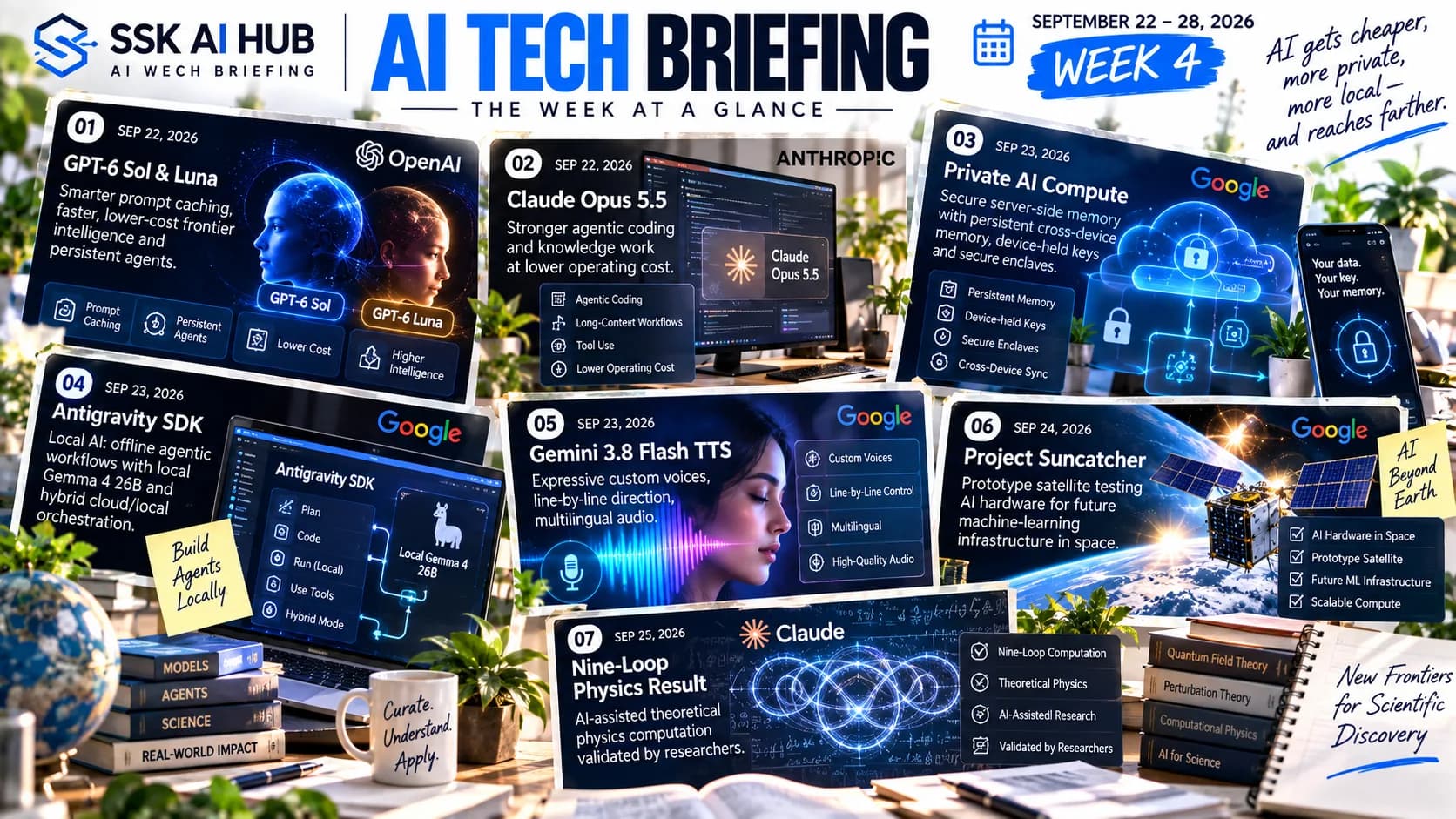
This edition covers September 22–28, 2026 only. Week 4 was not defined by one giant model release. Instead, the stack around models changed: OpenAI pushed frontier capability down the cost curve with GPT-6 Sol and Luna while making prompt caching visible and controllable, Anthropic introduced Claude Opus 5.5 for more efficient long-running agentic coding, Google described a privacy-preserving persistent-memory architecture for Private AI Compute, the Antigravity SDK added a hybrid cloud-planner-plus-local-agent pattern, Gemini 3.8 got expressive, directable text-to-speech, Project Suncatcher began testing whether AI hardware can survive orbit, and Anthropic published a human-validated example of Claude executing a nine-loop physics calculation.
The common thread: AI is becoming an infrastructure problem as much as a model problem — differentiated by where inference runs, what a system remembers, how much it costs, how private it is, and how reliably its outputs can be verified.
The seven developments below were selected from a broader candidate pool for their significance within the window, not to fill a fixed quota. Because this edition closes on September 28, one further item announced that same day — after the rest of this week's reporting was already set — is noted under Worth Watching rather than folded into the Top 7.
This week's reading list
| Development | Announcement date | The question for builders |
|---|---|---|
| GPT-6 Sol & Luna | September 22 | Are you tracking cache hit rate as an agent-system metric, not just cost and latency? |
| Claude Opus 5.5 | September 22 | For your coding agent, does completion quality hold up when you also count steps and wall-clock time? |
| Private AI Compute memory | September 23 | If your product remembered users across devices, could you explain exactly who can decrypt that memory? |
| Antigravity SDK local models | September 23 | Could a task you send to the cloud today run locally instead, with only metadata leaving the device? |
| Gemini 3.8 TTS | September 23 | Does your voice pipeline track consent and provenance, or only audio quality? |
| Project Suncatcher | September 24 | Which of your own AI bottlenecks are really energy, cooling or networking problems in disguise? |
| Claude's nine-loop physics result | September 25 | In an AI-for-science workflow, is there an unbroken chain from method to independent validation? |
| Claude Sonnet 5.5 | September 28 | With two Claude 5.5 releases in one week, which tier actually fits your workload's cost and latency budget? |
Story 1. GPT-6 Sol & Luna push frontier intelligence down the cost curve
What happened?
OpenAI launched GPT-6 Sol and GPT-6 Luna, two lower-cost tiers that OpenAI says inherit much of the capability progress behind GPT-6 Astra. OpenAI lists API pricing of $2/M input and $10/M output for Sol, and $0.10/M input and $0.50/M output for Luna — each 50% below GPT-5.6 promotional pricing, per OpenAI. GPT-6 Sol and Luna announcement
Alongside the launch, OpenAI upgraded prompt caching for GPT-6: higher cache hit rates, a 30-minute shared-prefix cache-discount window, a Prompt Caching Dashboard, cache-miss diagnostics, and explicit controls aimed at persistent agents. Better prompt caching for GPT-6
Why it matters
A long-running agent often resends the same system instructions, tool definitions and context at every step. If that repeated context can be reused instead of recomputed, both latency and cost can fall substantially — turning caching from a hidden implementation detail into explicit architecture.
Practical Applications
Demonstrated / Stated applications
- Lower-cost API access to GPT-6-family capability through Sol and Luna (OpenAI)
- Cache hit-rate monitoring, miss diagnostics and a Prompt Caching Dashboard for persistent agents (OpenAI)
Potential applications
- Persistent coding agents
- Multi-step research workflows
- Long-running operations agents
- High-volume customer-support or enterprise agents
Real-World Example
A coding agent working for several hours on a large repository may repeatedly carry thousands of tokens of instructions, architecture notes and tool definitions. Better caching means the system can reuse more of that stable context while the model focuses compute on the new work in front of it.
Developer Takeaway
Start tracking cache hit rate as an agent-system metric alongside task success, latency, retries and cost — a cache-breaking prompt change can quietly undo the economics Sol, Luna and better caching are meant to deliver.
Source attribution — OpenAI — GPT-6 Sol and Luna, and better prompt caching for GPT-6
Pricing and cache-behavior figures are OpenAI's own reported numbers; keep them attributed rather than restated as independent benchmarks.
Story 2. Claude Opus 5.5 targets bigger agentic jobs with better efficiency
What happened?
Anthropic introduced Claude Opus 5.5, saying it reaches Fable 5.1-level performance on most work while costing about 40% less to run than Opus 5 on typical workloads. Anthropic lists pricing at $4/M input, $20/M output and $0.20/M cache reads, and reports output generation more than 30% faster than Opus 5. Introducing Claude Opus 5.5
The release is oriented toward long, sprawling tasks such as repository-wide migrations, audits and research jobs, where every additional model turn and tool call adds time and money.
Why it matters
For autonomous coding, every model turn and every tool call adds time and money. A model that solves the same task in fewer steps, at lower cost, can change the economics of unattended software work — not just its ceiling on raw capability.
Practical Applications
Demonstrated / Stated applications
- Reports of roughly 40% lower typical-workload cost and 30%+ faster output generation versus Opus 5 (Anthropic-stated)
Potential applications
- Multi-repository engineering changes
- Large code migrations
- Software audits
- Long-running research tasks
- Knowledge-work automation
Real-World Example
Instead of asking an AI to write one function, an engineer could ask it to inspect several connected services, plan a cross-repository change, modify the relevant code, run tests, diagnose failures and produce a final change summary — with cost and turn count staying manageable across the whole job.
Developer Takeaway
For coding agents, compare completion quality + number of steps + tokens + wall-clock time, not only benchmark accuracy. Anthropic's cost and speed claims are vendor-reported and should be validated against your own workloads before being treated as guaranteed.
Source attribution — Anthropic — Introducing Claude Opus 5.5
Cost, speed and performance comparisons against Opus 5 are Anthropic's own reported figures; state them as Anthropic's claims, not independently verified benchmarks.
Story 3. Google describes secure server-side memory for Private AI Compute
What happened?
Google DeepMind described a persistent server-side memory layer for Private AI Compute built on encrypted per-user storage, device-held keys, authenticated end-to-end encrypted channels and secure enclaves. Advancing Private AI Compute with secure server-side memory
In the described design, requests travel over authenticated end-to-end encrypted channels into isolated secure enclaves, where user context is temporarily decrypted for processing and then re-encrypted, while the keys needed to unlock stored memory remain on the user's own devices.
Why it matters
AI assistants become far more useful when they remember context across sessions and devices, but persistent memory creates a major privacy problem. This architecture is Google's attempt to combine cloud-scale model capability with device-like privacy properties, rather than treating memory as ordinary readable server data.
Practical Applications
Demonstrated / Stated applications
- A described architecture for encrypted, per-user server-side memory with device-held keys and secure enclaves (Google DeepMind)
Potential applications
- Cross-device AI assistants
- Long-term preference memory
- Private productivity agents
- Personal knowledge continuity
Real-World Example
A user starts a complex task on a laptop, continues it later on a phone, then resumes again through another device. The assistant remembers relevant context without treating that personal history like ordinary readable server data.
Developer Takeaway
Memory architecture should be designed around key ownership, isolation, retention, verification and user control from day one — this is Google's description of how the layer is meant to work, not evidence of how broadly it has already been deployed.
Source attribution — Google DeepMind — Advancing Private AI Compute with secure server-side memory
This describes an architecture for how the memory layer is meant to work; treat it as Google's own account rather than an independent audit of production deployment.
Story 4. Antigravity SDK pairs a cloud planner with a local agent workforce
What happened?
Google's Antigravity SDK added support for local AI model workflows, initially featuring Gemma 4 26B running through LiteRT. Introducing support for local AI models in the Antigravity SDK
Google demonstrated an "Architect-Builder" pattern in which Gemini 3.8 Flash acts as a cloud planner while local Gemma 4 26B agents execute on the user's own machine. In Google's recorded security-audit example, source code stayed local while the cloud model received only limited task metadata; this specific token split is a demonstration, not a number to generalize to every workload.
Why it matters
This pattern separates reasoning placement from data placement: the most capable cloud model does not need to see every private token or file to still direct the work, which reframes hybrid AI design around privacy and data locality rather than only model quality.
Practical Applications
Demonstrated / Stated applications
- Local workflows in the Antigravity SDK using Gemma 4 26B via LiteRT, paired with Gemini 3.8 Flash as a cloud planner (Google)
Potential applications
- Private source-code analysis
- On-device automation
- Local security testing
- Offline agent workflows
- Hybrid enterprise assistants
Real-World Example
A company can ask a cloud model to plan how to audit a codebase while local models inspect and patch proprietary code that never leaves the workstation — the cloud planner reasons about the task without ever holding the source itself.
Developer Takeaway
Hybrid AI can route tasks by privacy, compute need, latency and capability — not just by model quality. Treat Google's demonstration token split as an example, not a benchmark to replicate exactly.
Source attribution — Google Developers — Local AI models in the Antigravity SDK
The recorded security-audit token split is a specific demonstration example; do not generalize it as a general-purpose metric.
Story 5. Gemini 3.8 TTS turns voice generation into a directable performance
What happened?
Google introduced Gemini 3.8 Flash TTS and Flash-Lite TTS, new text-to-speech models supporting custom voice creation, line-by-line performance direction and expressive multilingual delivery. Gemini 3.8 TTS announcement
Google says the models support more than 100 languages and dialects and include safety mechanisms for voice replication, including consent verification, SynthID watermarking and C2PA credentials.
Why it matters
Text-to-speech is moving from "read this sentence" toward "direct an actor": creators can shape delivery, pacing and emotional tone line by line rather than accepting one fixed voice reading text aloud.
Practical Applications
Demonstrated / Stated applications
- Custom voice creation, line-by-line direction, 100+ language/dialect support, and consent/SynthID/C2PA safety tooling (Google)
Potential applications
- Multilingual voice agents
- Audiobooks and podcasts
- Game characters
- Dubbing
- Education and accessibility tools
Real-World Example
A global support system could use one consistent brand voice while dynamically adjusting language, pacing and conversational style for each customer interaction, with consent and provenance metadata attached to every generated clip.
Developer Takeaway
Voice UX now needs evaluation for latency, pronunciation, emotional consistency, consent and provenance — not just raw audio quality.
Source attribution — Google — Gemini 3.8 Flash TTS and Flash-Lite TTS
Language coverage and safety-tooling claims (consent verification, SynthID, C2PA) are Google's own reported feature set.
Story 6. Project Suncatcher will test whether AI compute can move into orbit
What happened?
Google detailed Project Suncatcher's first in-orbit hardware test: a prototype satellite mission intended to evaluate whether Google's AI hardware and TPUs can survive radiation, launch vibration, thermal extremes and vacuum-cooling constraints. Project Suncatcher facts
Google's longer-term research vision considers clusters of satellites connected by high-bandwidth laser links — a research direction, not an announced production system.
Why it matters
AI's infrastructure problem includes power, cooling and physical data-center constraints. Project Suncatcher is testing an extreme alternative to terrestrial data centers — it is not a claim that orbital AI data centers are production-ready.
Practical Applications
Demonstrated / Stated applications
- A planned prototype satellite mission to test AI hardware resilience in orbit (Google)
Potential applications
- Orbital machine-learning infrastructure research
- Laser-linked satellite compute clusters
- Radiation-tolerant and thermally resilient AI hardware design
Real-World Example
Before anyone can seriously imagine large-scale orbital AI compute, engineers first need evidence that accelerators can survive the physical launch and space environment and communicate reliably — this mission is that first evidence-gathering step.
Developer Takeaway
Some AI bottlenecks are no longer software problems. They are energy, cooling, networking and hardware reliability problems — worth watching even for teams with no near-term use for orbital compute.
Source attribution — Google — Project Suncatcher facts
This is a research prototype and mission plan, not evidence of a production orbital data center.
Story 7. Claude computes a nine-loop physics amplitude, independently validated
What happened?
Anthropic published a guest account describing Claude computing a nine-loop amplitude in N=4 super-Yang-Mills theory using established computational methods. Yes, Claude can do nine loops
Researcher Lance Dixon independently validated the result. The post emphasizes that Claude used methods already built by the human research community, implementing and coordinating a fragile computational pipeline rather than discovering a new physical principle.
Why it matters
This is a strong example of AI acting as a scientific computation partner — executing a difficult, previously established recipe reliably at scale — while human researchers remain responsible for validation and interpretation of the result.
Practical Applications
Demonstrated / Stated applications
- A nine-loop amplitude in N=4 super-Yang-Mills computed using established methods and independently validated by Lance Dixon (Anthropic / Lance Dixon)
Potential applications
- Symbolic mathematics
- Scientific code generation
- Large experimental/research pipelines
- Reproducibility assistance
Real-World Example
A researcher gives an AI a published computational method, access to ordinary research compute and a target result. The AI implements and coordinates the calculation while the researcher independently validates the outcome before it counts as evidence.
Developer Takeaway
For AI-for-science systems, preserve a chain of method → code → computation → evidence → independent validation — do not describe results like this one as AI discovering a new physical law; it executed known methods that a human then checked.
Source attribution — Anthropic — Yes, Claude can do nine loops
This is a guest research account emphasizing that established human-built methods were used and that the result was independently validated; it is not a claim of new physics discovered by AI.
Worth watching
September 28
Anthropic ships Claude Sonnet 5.5
On the last day of this edition's coverage window, Anthropic released Claude Sonnet 5.5, which Anthropic says runs about 30% faster and costs up to 30% less than Sonnet 5 for most work, while matching or exceeding Opus 5.5 on some tasks. Introducing Claude Sonnet 5.5
This is the second Claude 5.5-generation release in one week, alongside Claude Opus 5.5 covered above. Because it landed after this week's reporting was already set, and because the two releases together are really one continuing story about the Claude 5.5 generation, it's noted here as a same-week follow-up rather than folded into the Top 7 or given its own separate ranking.
AI is spreading across the whole stack, not just getting smarter
This week's seven stories arrange into one stack: frontier models, cost and caching, memory and privacy, local/cloud routing, multimodal interfaces, physical infrastructure, and science and real-world work. The next generation of AI products will be differentiated less by model intelligence alone and more by where inference runs, what the system remembers, how much it costs, how private it is, how it interacts with people, and how reliably its outputs can be verified.
Cost and caching are becoming explicit architecture
GPT-6 Sol and Luna, plus visible caching controls, turn inference economics into something developers actively design for rather than a hidden backend detail.
Long-running agents are judged on steps, not just accuracy
Claude Opus 5.5's efficiency framing shows that for agentic coding, fewer steps and lower cost per task matter as much as raw benchmark performance.
Memory needs privacy built in from the start
Private AI Compute's device-held keys and secure enclaves treat persistent memory as a privacy-architecture problem, not an afterthought bolted onto storage.
Local and cloud AI are becoming complementary, not competing
The Antigravity SDK's cloud-planner-plus-local-execution pattern separates reasoning placement from data placement.
Interfaces are becoming more expressive and controllable
Gemini 3.8 TTS turns voice from a fixed narration layer into a directable performance medium, with consent and provenance tooling attached.
AI's infrastructure bottlenecks are now physical
Project Suncatcher is testing whether hardware constraints around power, cooling and radiation can be pushed into an entirely new environment.
AI is a scientific collaborator when humans still validate the result
Claude's nine-loop physics result shows AI executing serious computation while a domain expert remains responsible for checking it.
The next coverage window is September 29–30, 2026, followed by the September month-end recap. This issue covers September 22–28 only; it is the fourth weekly edition of the month, not the month-end newsletter.
Three project concepts from this issue
Three ways to combine this week's developments into something you could actually build, from a privacy-aware persistent agent that routes between local and cloud models to a cache-economics dashboard and a hybrid privacy router.
Privacy-Aware Persistent Agent
A long-running agent that classifies each task for privacy and difficulty, routes it to a local or cloud model, keeps encrypted memory, and asks for human approval when it crosses a risk boundary.
- Problem
- Long-running agents need memory and repeated context to be useful, but persistent memory and constant cloud calls create privacy and cost problems at the same time.
- From this issue
- Combines this week's local/cloud routing pattern, encrypted persistent-memory architecture, and cache-economics discipline into one system.
- How it works
- A user goal passes through a policy and privacy classifier, then a planner routes execution to local models for private data or cloud models for hard reasoning; results are written to encrypted memory, optimized through a cache/context layer, checked by an evaluator, and returned after human approval when needed.
- Who
- Agent-platform teams building assistants that need to remember context across sessions without centralizing sensitive data.
- Why useful
- Demonstrates model routing, local AI, cloud reasoning, caching, persistent memory, privacy design, evaluation and human control in one coherent architecture.
GOAL
A user goal enters a policy and privacy classifier that decides what the task is allowed to touch
PLAN
A planner decomposes the goal and hands the work to an execution router
ROUTE
The router splits work between local models for private data and cloud models for harder reasoning
REMEMBER
Results pass through encrypted, per-user memory and a cache/context optimizer that reuses stable context
EVALUATE
An evaluator checks the result and requests human approval whenever a defined risk boundary is crossed
RESULT
An approved result is returned to the user
Persistent Agent Cost Dashboard
A dashboard that traces each agent step, separates cached from uncached context, finds cache-breaking prompt changes, and recommends prompt-layout fixes.
- Problem
- Teams running persistent agents often can't see where caching is failing or how much it's actually saving.
- From this issue
- Follows directly from GPT-6's newly visible caching controls and Prompt Caching Dashboard.
- How it works
- Agent trace log → cache hit/miss classifier → cost delta calculator → cache-breaking-change detector → prompt-layout recommendations.
- Who
- Teams operating high-volume or long-running agents where inference cost is a real budget line item.
- Why useful
- Turns cache hit rate into a first-class, monitored metric instead of an invisible backend detail.
Hybrid Privacy Router
A router that classifies each task and decides whether it should run locally, in the cloud, or in a split architecture.
- Problem
- Sending every task to the most capable cloud model unnecessarily exposes private data and adds cost and latency.
- From this issue
- Follows the Antigravity SDK's cloud-planner-plus-local-execution pattern.
- How it works
- Task → privacy/compute/latency classifier → local execution, cloud execution, or a split plan-locally-execute-remotely route → result.
- Who
- Teams building agents over sensitive source code, documents, or user data that shouldn't leave the device unnecessarily.
- Why useful
- Shows how to route by privacy and data locality, not only by model quality, as local models get more capable.
Sources & Verification
OpenAI — GPT-6 Sol and Luna, and better prompt caching for GPT-6
Pricing and cache-behavior figures are OpenAI's own reported numbers; keep them attributed rather than restated as independent benchmarks.
Anthropic — Introducing Claude Opus 5.5
Cost, speed and performance comparisons against Opus 5 are Anthropic's own reported figures; state them as Anthropic's claims, not independently verified benchmarks.
Google DeepMind — Advancing Private AI Compute with secure server-side memory
This describes an architecture for how the memory layer is meant to work; treat it as Google's own account rather than an independent audit of production deployment.
Google Developers — Local AI models in the Antigravity SDK
The recorded security-audit token split is a specific demonstration example; do not generalize it as a general-purpose metric.
Google — Gemini 3.8 Flash TTS and Flash-Lite TTS
Language coverage and safety-tooling claims (consent verification, SynthID, C2PA) are Google's own reported feature set.
Google — Project Suncatcher facts
This is a research prototype and mission plan, not evidence of a production orbital data center.
Anthropic — Yes, Claude can do nine loops
This is a guest research account emphasizing that established human-built methods were used and that the result was independently validated; it is not a claim of new physics discovered by AI.
Anthropic — Introducing Claude Sonnet 5.5
Speed and cost comparisons against Sonnet 5, and any claim of matching or exceeding Opus 5.5, are Anthropic's own reported figures.
Get the next SSK AI Hub briefing directly on LinkedIn.
Subscribe on LinkedIn (opens in a new tab)