

AI in August 2026: 10 Developments That Defined the Month
Vol. 1Month in ReviewCovering August 2026
AI engineering is moving from choosing the best model to engineering the best system around the model.
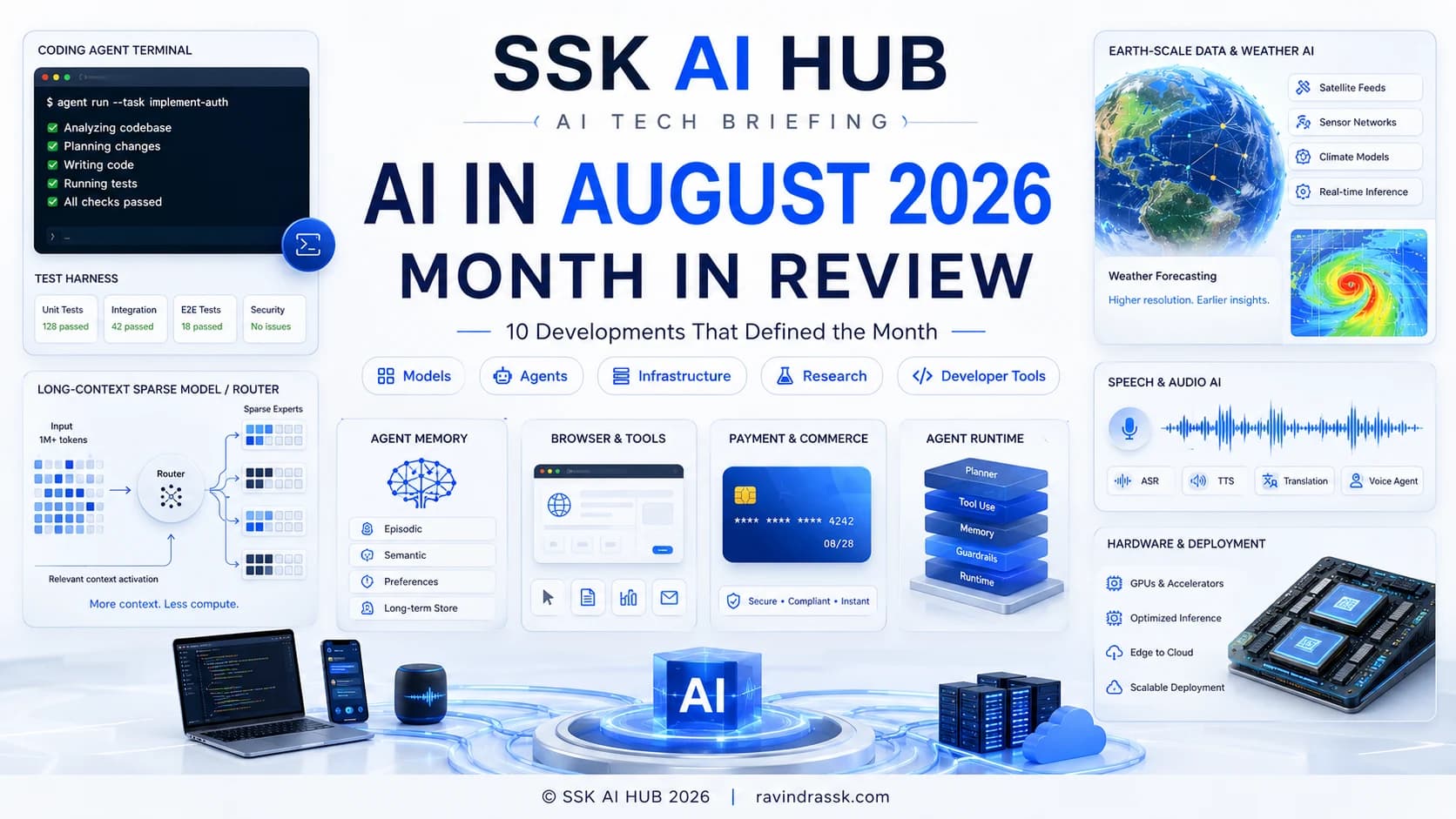
- 4weekly editions
- 24stories reported
- 10developments selected
August produced a steady stream of AI announcements. If you read only the headlines, it looked like noise: new models, new tools, new acronyms. Followed week by week, a much clearer story emerged — and it wasn't really about any single model getting smarter.
Across four weekly SSK AI Hub briefings covering 24 stories, the pattern was the machinery growing around the models: agents that keep working after the chat ends, wallets and spending limits, standard plugs into documents, devices and payments, and better ways to test what these systems can actually do. Here are the ten developments that best explain the month — each in plain language, each linking to the full technical analysis in its weekly edition.
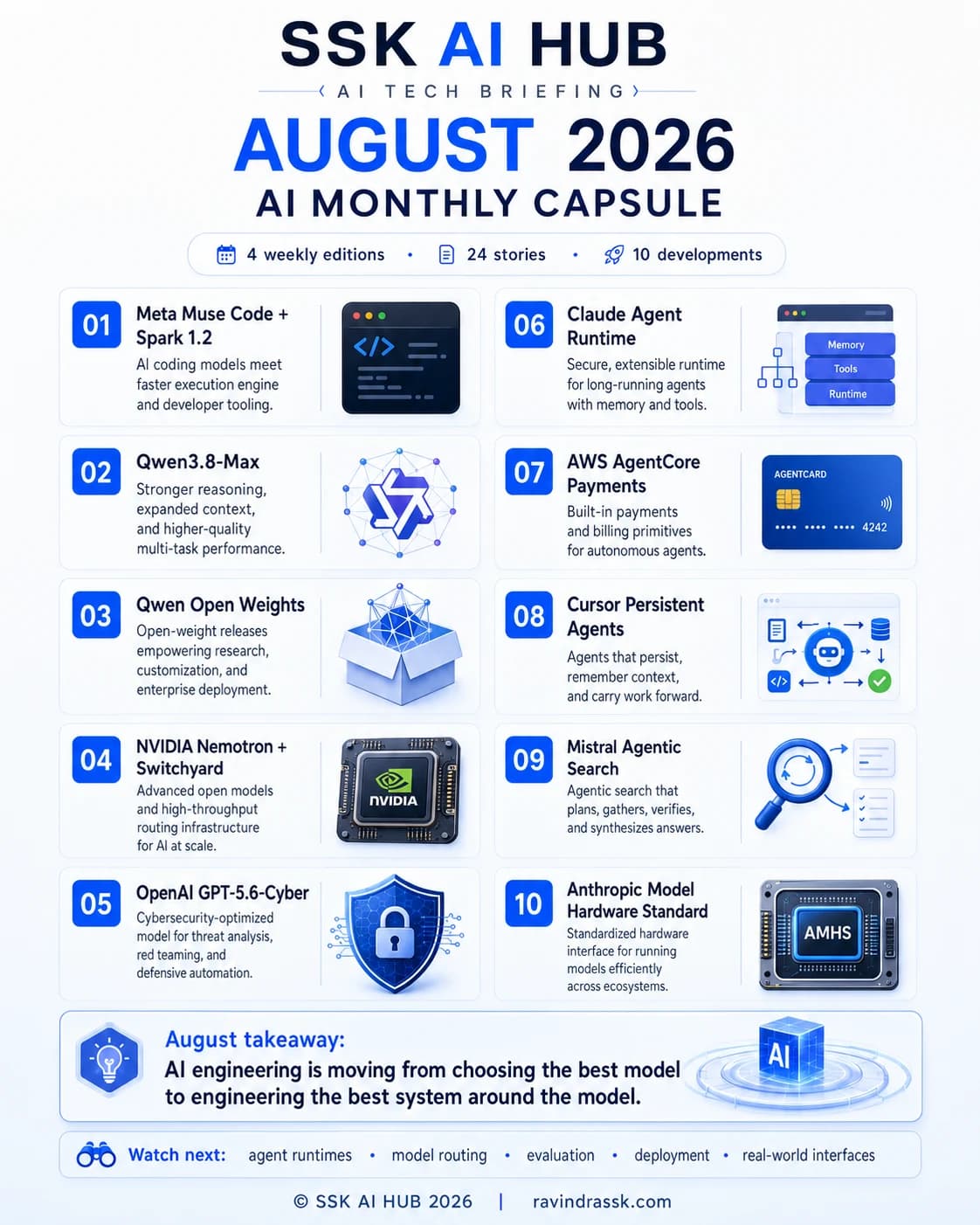
The 10 developments that defined August
Meta Muse Code + Muse Spark 1.2
What happened
Meta released Muse Code, a coding agent in beta, powered by Muse Spark 1.2 — a model trained together with the very agent system it runs inside, including its goals, memory management and helper agents.
Why it matters
Coding agents usually break at the seam between the model and the software wrapped around it. Training the two together closes that gap, and points at where serious coding agents are heading.
In simple wordsThe AI and the tool that runs it were built as one team, not bolted together afterwards.
Alibaba Qwen3.8-Max
What happened
Alibaba launched its largest model as a developer API: it reads text, images and video, handles very long documents, and can call tools directly.
Why it matters
Frontier-scale AI arrived as a platform component developers can rent by the call — collapsing whole categories of pipeline work into single requests and sharpening competition at the top end.
In simple wordsA top-tier AI became something you plug into your own software, not just a chat website.
Qwen's frontier model goes open-weight
What happened
Days later, Qwen published the model family's weights openly, with popular open-source serving tools supporting them from day one.
Why it matters
Organizations that cannot send data to outside services can now run frontier-class AI on their own machines — turning a policy dead end into an engineering decision.
In simple wordsOne of the world's most capable AI models became something you can download and run yourself.
NVIDIA Nemotron Lightning + NeMo Switchyard
What happened
NVIDIA released a small, efficient open model built for the repetitive work inside AI agents, plus routing software that decides when a task needs the big expensive model and when the small one will do.
Why it matters
Most of what an agent does is routine. Routing that work to a cheaper model directly attacks the cost problem that keeps long-running agents out of production.
In simple wordsThe expensive AI brain is saved for hard decisions; a cheaper helper handles the busywork.
OpenAI GPT-5.6-Cyber and the Daybreak program
What happened
OpenAI built a cybersecurity-specialized model and made it available only through an approval-gated access program, with tiers for defenders and vetted specialists.
Why it matters
It sets a template for handling powerful dual-use AI: the capability ships, but paired with verification of who gets it — a pattern likely to spread to other sensitive domains.
In simple wordsThe most sensitive AI tools now come with a background check.
Claude's agent runtime fills out
What happened
Anthropic moved core agent building blocks out of beta — computer use, files, reusable skills — and added a browser toolset, attachable memory, web-access controls and a session inspector that shows what an agent did and what it cost.
Why it matters
Everything an agent needs to run like real software — storage, input/output, guardrails, debugging — now ships together in one supported runtime instead of a kit of betas.
In simple wordsAI assistants got a proper operating system to live in.
AWS AgentCore Payments
What happened
AWS made it generally available for agents to pay for APIs, services and content — with spending limits enforced below the agent and every transaction logged.
Why it matters
Paying becomes something agents can do safely, and selling to agents becomes a real market. The guardrails are the point: this is policy-bounded spending, not a blank cheque.
In simple wordsAI assistants got a wallet — with a strict allowance and a full receipt trail.
Cursor's agents go persistent and event-driven
What happened
Cursor's cloud coding agents can now react to pull requests, chat messages and schedules, hold a long-term goal, and keep working across sessions on isolated machines.
Why it matters
It is the clearest picture yet of coding agents as ongoing workers rather than per-question tools — the same shift that once turned scripts into always-on services.
In simple wordsThe coding assistant stopped waiting to be asked.
Mistral Agentic Search
What happened
Mistral released a search toolkit where the model investigates documents step by step — searching, opening, reading and checking that the evidence actually supports each claim — instead of one blind lookup.
Why it matters
Answers that come with checkable evidence are the missing piece for using AI seriously on contracts, filings and manuals, where a confident misquote is worse than no answer.
In simple wordsThe AI now shows its sources instead of asking to be trusted.
Anthropic Model Hardware Standard
What happened
Anthropic previewed a standard way for AI models to operate programmable physical devices — lab instruments, robotics — with each device's safety limits built into the interface itself.
Why it matters
If it is adopted, connecting AI to real machines becomes routine engineering instead of a custom project each time — the same move that standardization made for software tools.
In simple wordsA common plug between AI and real-world machines, with the safety rules wired into the plug.
What August added up to
AI engineering is moving from choosing the best model to engineering the best system around the model.
A year ago, building with AI mostly meant picking a model and writing a good prompt. August's developments show how much that has changed. The differences that mattered this month were in everything surrounding the model: the tools it can call, the memory it keeps, the routing that decides which model handles which step, the permissions and spending limits that keep it inside the lines, the evaluations that check whether it actually works, and the runtimes that let it keep working after you close the tab. None of that replaces the model — it multiplies it. For teams, the practical shift is real: the questions worth asking are less 'which model is smartest?' and more 'what system do we build around it, and how do we keep that system safe, testable and affordable?'
What to watch in September
Agent runtimes
August ended with agents gaining files, memory, browsers and event loops. Worth watching: whether the major runtimes converge on shared building blocks or harden into separate silos.
Model routing
Pairing small executor models with big reasoners was one of the month's most practical ideas. Worth watching: whether routing becomes standard middleware in agent stacks.
Evaluation
August's double-blind evaluation pilot treated testing as infrastructure. Worth watching: whether more labs submit models to tests they cannot see in advance.
Deployment
Tools that take open models from checkpoint to fast production runtimes cut real friction in August. Worth watching: how quickly they show up inside mainstream serving stacks.
Real-world interfaces
Standards for hardware, speech models and payment rails all pointed the same way: AI acting beyond the chat box. Worth watching: which of these interfaces attracts adoption beyond its authors.
Explore August week by week
August 1–7, 2026
SSK AI: The Week the Model Became a Component
The important unit is no longer the model — it is the system built around it: harness, tools, packaging, policy, action.
August 6–12, 2026
SSK AI: The Week AI Split Into Specialists
From one giant model to systems of specialized, cooperating intelligence.
August 15–21, 2026
SSK AI: The Week Agents Became a Platform
Agents are becoming a computing platform: memory, browser control, event loops, payments, iterative search, safety layers, adaptive training and specialized collaborators.
August 22–28, 2026
SSK AI: The Week AI Broke Out of the Model
AI is breaking out of the model: this week's progress was interfaces — to physical hardware, human speech, Earth-scale data, GPUs, production runtimes and trustworthy evaluation.
Get the next SSK AI Hub briefing directly on LinkedIn.
Subscribe on LinkedIn (opens in a new tab)