

SSK AI — What Changed in AI & What You Can Build | August 8, 2026
Vol. 1Weekly No. 1Covering August 1–7, 2026
The important unit is no longer the model — it is the system built around it: harness, tools, packaging, policy, action.
SSK AI
What Changed in AI & What You Can Build
The model is no longer the product — the system around it is.
- Meta co-trains a coding model with its agent harness
- Qwen3.8-Max: 2.4T sparse parameters, API-first
- DeepMind open-sources cyclone forecasting models
- Agent skills become portable, packaged artifacts
- Mistral ships programmable safety in the open
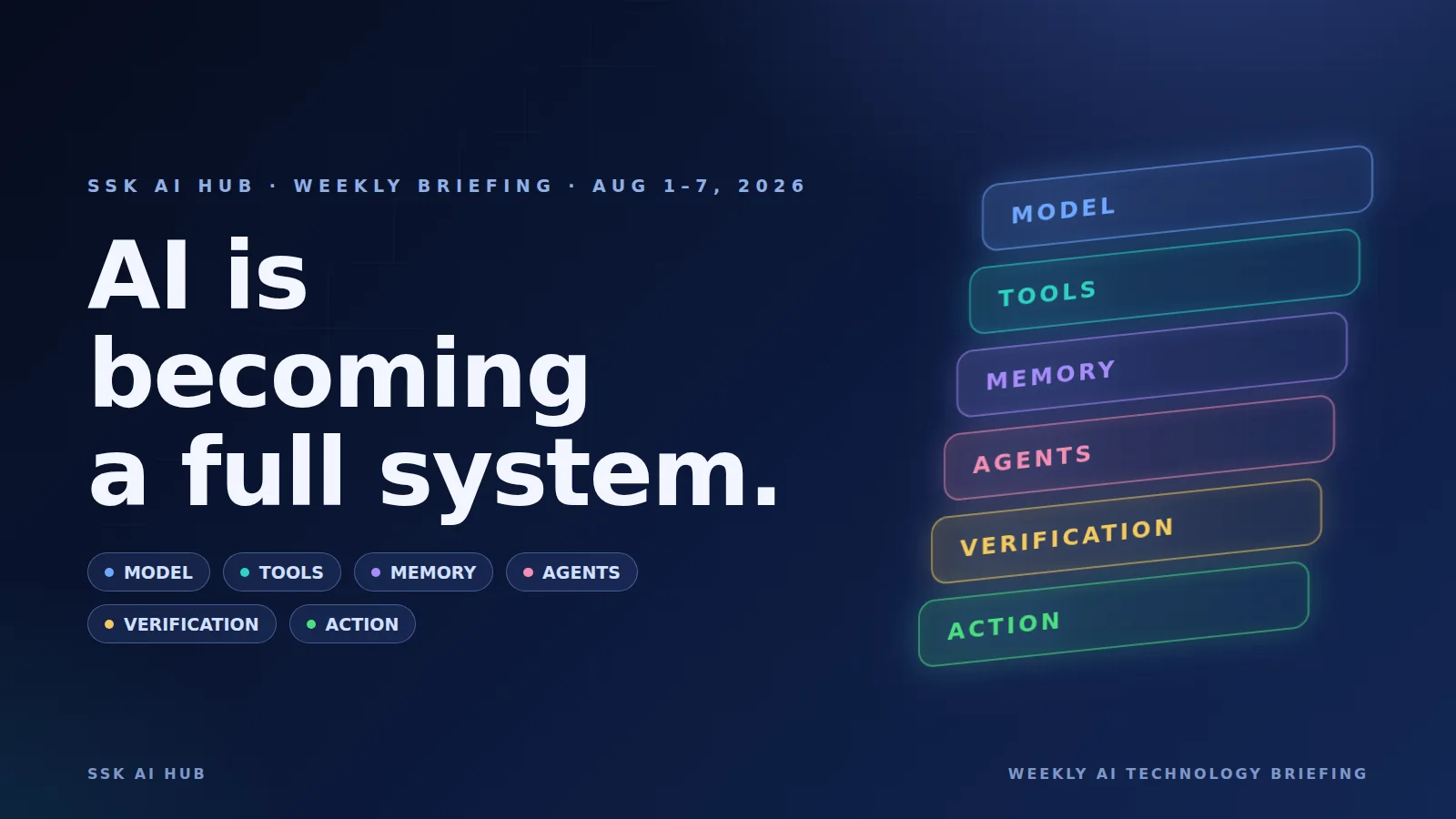
Cover the same seven days with the logos removed and one pattern is left standing. Meta's biggest coding release wasn't a model — it was a model trained inside the agent harness it ships with. Alibaba's frontier launch arrived not as weights but as a platform: tools, multimodal input and a million-token window behind an API. The week's most quietly important document was a packaging specification, and Mistral's contribution to safety was a model whose policies are written at inference time, in plain language.
None of these compete on a leaderboard score. They compete on the system around the model — how it is trained with its tools, how its capabilities are packaged and moved, how its behavior is governed, and how its outputs reach the real world. Even the week's science story fits: Google DeepMind open-sourced not a cyclone paper but a runnable forecasting stack, ensembles and all.
This first weekly edition of SSK AI Hub picks the five developments from August 1–7 that best answer the questions this publication exists for: what changed, why it matters, where it can actually be used, and what you can build with it.
Story 1. Meta Trains a Coding Model Inside the Agent That Ships It
What happened?
On August 5, 2026, Meta released Muse Code in beta — a terminal coding agent for complex software-engineering work across large repositories — powered by a new model, Muse Spark 1.2. The agent can coordinate multiple persistent, asynchronous background agents, and the model is available both inside Muse Code and through the Meta Model API.
The unusual part is how the two were built. Meta says Spark 1.2 was co-trained with the Muse Code harness itself: its training included harness trajectories covering goals, context compaction and subagent coordination, plus long-horizon coding work up to whole-repository generation and large end-to-end projects.
What's actually new?
Most coding agents are assembled after the fact — take a strong general model, wrap it in scaffolding, hope the two cooperate. Here the scaffolding is part of the training distribution: the model learned to set goals, compact its own context and delegate to subagents because those operations were in its training data. That collapses the seam where agent products usually fail — the gap between what the model saw in training and what the harness asks of it at runtime.
Persistent asynchronous subagents push in the same direction: the unit of work stops being a chat turn and becomes a long-running engineering task that survives beyond a single session.
Why it matters
If co-designing model and harness measurably beats bolting a harness onto a general model — Meta's benchmark results are Meta-reported, so treat that as the claim under test — every serious agent vendor will need to own or deeply integrate a training loop, not just an API key. For engineering teams, it signals where coding agents are heading: away from autocomplete, toward delegated, repository-scale work.
Practical Applications
Demonstrated / Stated applications
- Repository-scale coding, debugging, planning, code generation and long-horizon workflows, including GPU-kernel optimization (Meta's announcement)
Potential applications
- Long-running repository migrations and refactoring campaigns
- Parallel bug investigation and multi-agent CI repair
Real-World Example
A platform team owns a sprawling monorepo with a backlog of mechanical work: framework upgrades, deprecated-API cleanups, flaky-test triage. With a terminal agent built for repository scale, they experiment during the beta: one persistent background agent chips away at a migration branch while another investigates a failing test suite, both reporting back asynchronously. The engineers' job shifts from typing the changes to reviewing them — an experiment in delegation, not a proven replacement for it.
Developer Takeaway
Concrete facts to file: Muse Code is a terminal agent in beta; Spark 1.2 is reachable via the Meta Model API; the model was co-trained with harness trajectories (goals, context compaction, subagents) and for long-horizon coding. If you build agent products, the design lesson travels even if you never touch Meta's stack: the harness is not packaging around the model — it is part of the model's environment, and training that ignores it leaves capability on the table. Performance claims are Meta-reported; validate on your own repositories.
Source attribution — Story 1 — Meta Muse Code + Muse Spark 1.2
Primary source: Meta AI research blog announcement. Muse Code is a beta release. All benchmark and optimization results, including GPU-kernel work, are Meta-reported; this article cites no comparative numbers.
Story 2. Alibaba Launches Qwen3.8-Max: 2.4 Trillion Sparse Parameters, API-First
What happened?
On August 3, 2026, Alibaba announced Qwen3.8-Max and made it available globally through Alibaba Cloud Model Studio APIs. The model carries 2.4 trillion total parameters with roughly 95 billion activated per token, built on a sparse Mixture-of-Experts design with hybrid attention. (In an MoE model, only a fraction of the parameters compute for each token — which is what makes this scale computationally manageable at all.)
Alibaba states context support up to 1 million tokens; Model Studio documentation lists text, image and video input, with function calling and structured outputs. One timing detail matters for the record: on August 3 Alibaba said the model weights were scheduled for release the following week — during this edition's window, Qwen3.8-Max was an API model, not an open-weight one.
What's actually new?
Individually, none of the ingredients is unprecedented — sparse MoE at trillions of parameters, million-token contexts and multimodal input all exist. Combining them in one flagship, exposed day-one through a developer API with tool calling and structured outputs, is the move: the launch treats a frontier model less as a chat destination and more as a programmable platform component.
The staged openness is itself notable. Announcing an API launch with weights promised a week later turns an open-weight release into a rollout strategy rather than a single event.
Why it matters
For developers, a 1M-token multimodal frontier model behind a metered API collapses several categories of pipeline work — chunking, transcription passes, separate vision models — into single calls. For the ecosystem, a fourth serious frontier platform intensifies price and capability competition. Alibaba's positioning claims about coding, long-horizon and agentic performance are Alibaba-reported; the architecture and access facts stand on their own.
Practical Applications
Demonstrated / Stated applications
- Coding, professional and office work, research, long-horizon tasks and visual understanding (Alibaba's announcement and Model Studio documentation)
Potential applications
- Agents that reason over entire large codebases in one context
- Long-document and video analysis pipelines without chunking infrastructure
Real-World Example
A legal-tech startup processes multi-hundred-page contract sets today with a retrieval pipeline: split, embed, retrieve, hope the right clause lands in context. Against a 1M-token window they prototype the naive alternative — load the entire contract set into one call, ask structured questions, get function-calling output straight into their review UI. Whether accuracy and cost beat their retrieval stack is exactly what the prototype must measure, but the experiment itself becomes an afternoon's work instead of a quarter's re-architecture.
Developer Takeaway
File the specifics: 2.4T total / ~95B active, sparse MoE with hybrid attention, up to 1M-token context (Alibaba-stated), text + image + video input, function calling and structured outputs, available through Alibaba Cloud Model Studio. Do not build on the weights yet — during August 1–7 they were announced as coming, not released. If long context is the draw, benchmark retrieval-versus-full-context on your own documents; a huge window changes the trade-off, it doesn't decide it.
Source attribution — Story 2 — Alibaba Qwen3.8-Max
Primary sources: Alibaba Cloud press announcement and Model Studio developer documentation. The 1M-token context and all capability positioning are Alibaba-stated; arena rankings and coding-duration comparisons circulating this week are likewise Alibaba-attributed and are not repeated here as fact. The model was not open-weight during August 1–7 — Alibaba said weights would follow the next week.
Story 3. Google DeepMind Open-Sources Its Cyclone Forecasting Models
What happened?
On August 6, 2026, Google DeepMind announced new WeatherNext cyclone forecasting work, with the underlying research published in Nature. The system predicts tropical-cyclone track, intensity and wind structure, generating up to 1,000 possible scenarios per cyclone with forecasts extending as far as 15 days.
The release went beyond the paper: Google open-sourced WeatherNext 2 and WeatherNext Cyclones — code and model weights — and shipped WeatherNext 2-mini, a compact variant Google describes as small enough to run on a single TPU through a public Colab notebook. Google also says WeatherNext contributed to real forecasting work during the 2025 hurricane season.
What's actually new?
Ensemble scale is the technical heart. Traditional physics-based ensembles are so computationally expensive that agencies run a few dozen members; an ML forecaster cheap enough to sample a thousand futures per storm changes what risk questions are even askable — not just where the cyclone will probably go, but how heavy the improbable tails are.
The openness is the ecosystem story. High-stakes forecasting models usually stay operational and closed; publishing weights and code — plus a single-TPU variant anyone can run in a notebook — moves AI weather prediction from a demonstration you read about to an instrument you can hold.
Why it matters
Cyclone forecasts sit upstream of evacuation calls, logistics reroutes and insurance exposure. Google's accuracy statements — including gains framed as extra days of warning — are research-reported claims from the Nature study, and WeatherNext is not a replacement for official meteorological agencies or warnings. What is unambiguous is access: researchers and engineers can now inspect, rerun and extend a frontier forecasting stack instead of taking its performance on faith.
Practical Applications
Demonstrated / Stated applications
- Tropical-cyclone forecasting research, disaster-preparation studies, renewable-energy planning and extreme-weather research (Google's announcement)
Potential applications
- Regional risk tools for logistics, insurance and climate analytics built on ensemble output
- Localized forecasting models fine-tuned by regional research groups
Real-World Example
A coastal university's atmospheric-science group has questions global agencies don't prioritize — how storm-surge risk distributes across their specific bay under rare but plausible tracks. With open weights, they rerun WeatherNext Cyclones over historical storms in their region, examine the full scenario spread rather than a headline track, and prototype localized analyses with 2-mini in a Colab before committing cluster time. Their outputs inform research and planning conversations — the official warning still comes from the meteorological agency.
Developer Takeaway
This is the week's most accessible frontier release: open code and weights, a Nature-published method, and a mini variant with a public notebook as the on-ramp. If you work anywhere near climate, logistics or risk, the ensemble output is the asset — a thousand scenarios per storm is a probability distribution you can integrate against, not a single trajectory to display. Treat accuracy claims as research-reported and validate against storms in your region of interest.
Source attribution — Story 3 — Google DeepMind WeatherNext
Primary source: Google DeepMind blog announcement, with the research published in Nature. Accuracy and lead-time gains are research-reported by Google. WeatherNext informs research and forecasting work; it is not a substitute for official meteorological agencies or public warnings.
Story 4. Agent Plugins 1.0 Makes Agent Capabilities Portable Packages
What happened?
On August 6, 2026, the Agent Plugins 1.0 specification was announced — an independently governed open standard defining a package format for distributing Agent Skills together with the MCP server configurations they depend on. (MCP — the Model Context Protocol — is the standard for connecting AI agents to external tools and data systems.)
Version 1.0 defines a shared package boundary and manifest, validation and failure-isolation behavior, portable path variables, and client-specific extension namespaces. The announcement says representatives from Amazon, Cursor, Microsoft, OpenAI and Vercel participated in its development, and positions the format as complementing MCP and Agent Skills rather than replacing either.
What's actually new?
MCP standardized the wire between an agent and its tools. What it never standardized is the layer above: how a reusable capability — a skill plus the tooling it needs — is bundled, validated and moved between agent products. Until now that has meant rebuilding the same capability per client, each with its own layout and conventions. A common manifest and package boundary is the boring, load-bearing piece that makes an ecosystem possible: the difference between snippets on a wiki and packages in a registry.
The deliberate narrowness is a design choice worth noticing: 1.0 standardizes packaging and validation, and explicitly does not standardize permissions, sandboxing, marketplaces, UI or trust.
Why it matters
Cross-vendor participation is the signal. If the clients people actually use adopt the format, capability authors write once and distribute everywhere, enterprises get one artifact type to review and govern instead of per-client sprawl, and switching agent products stops meaning rebuilding your tooling — lower lock-in as a side effect of a packaging spec. The unstandardized layers — trust, permissions, distribution — are now the obvious next battleground.
Practical Applications
Demonstrated / Stated applications
- Packaging a skill together with the MCP configuration it requires, carried between compatible clients as one artifact (the specification's stated scope)
Potential applications
- Enterprise plugin catalogs of vetted, versioned agent capabilities
- Reusable deployment and operations agents shared across teams and clients
Real-World Example
A platform team maintains a deployment capability — a runbook-shaped skill plus MCP servers for their CI, artifact store and incident tracker. Today it exists three times: once per agent client their engineers use, drifting apart with every edit. Packaged as one Agent Plugin, the skill and its MCP configuration ship together with a manifest; the package validates on install, path variables resolve per machine, and client-specific tweaks live in extension namespaces instead of forks. One artifact, reviewed once, running everywhere compatible.
Developer Takeaway
If you author agent skills or MCP servers, read the spec now — packaging conventions calcify fast, and capabilities structured as portable packages from day one will travel; ad-hoc ones will need repackaging. If you run an engineering org, this is the moment to start treating agent capabilities like dependencies: versioned, reviewed, catalogued. Scope discipline cuts both ways — nothing in 1.0 answers who may install a package or what it may touch. That is still on you.
Source attribution — Story 4 — Agent Plugins 1.0
Primary source: the Agent Plugins announcement on aaif.io. Participation by Amazon, Cursor, Microsoft, OpenAI and Vercel representatives is as stated in the announcement. Version 1.0 intentionally does not standardize client permissions, sandboxing, marketplaces, UI or trust.
Story 5. Mistral's Shieldstral Turns Moderation Into a Programmable Layer
What happened?
On August 4, 2026, Mistral released Shieldstral 1.0, an open-weight multimodal moderation and safety model under Apache 2.0. Mistral's documentation lists 3.8B parameters, text and image input, and a 32K context; Mistral says it runs on a single 16 GB NVIDIA GPU.
The defining feature is how policies work: instead of a fixed taxonomy baked in at training time, Shieldstral takes safety policies supplied as natural-language questions at inference time — the same model evaluates different policies for different products without retraining.
What's actually new?
Moderation models have historically frozen their worldview at training: a fixed label set, retraining required whenever the policy moves. Making the policy an inference-time input inverts that — the policy becomes data. A gaming chat, a medical assistant and an internal engineering tool can enforce genuinely different rules with one deployed model, and a policy change ships like a config change, versioned and reviewable, rather than a training run.
The demonstrated surface is wide for a safety release: prompt moderation, response moderation, prompt-response pair classification and refusal detection, over text and images.
Why it matters
Safety tooling has lagged the systems it is meant to govern — most teams choose between rigid hosted moderation endpoints and building classifiers from scratch. An Apache-2.0 model that runs on a single 16 GB GPU (Mistral-stated) makes a self-hosted, product-specific policy layer an ordinary engineering task, including for the data-sensitive deployments that cannot call external moderation APIs at all. Mistral's claims of outperforming larger models are vendor-reported — and a moderation model is one safety layer, not a safety system.
Practical Applications
Demonstrated / Stated applications
- Prompt and response moderation, prompt-response pair classification, refusal detection, and text and image safety filtering (Mistral's announcement and documentation)
Potential applications
- Enterprise safety gateways enforcing per-product policies in front of any LLM application
- Policy-aware agent systems that check planned actions against written rules before executing
Real-World Example
A company runs three AI products: a customer chatbot, an internal code assistant and a community forum with image uploads. Today each has hand-rolled filters that drift out of sync with the written policy. With a self-hosted Shieldstral instance, each product's policy lives as a set of plain-language safety questions in version control; the same 3.8B model answers all three sets. When legal tightens the harassment policy, the change is a reviewed pull request to a text file — live after redeploy, no retraining, no vendor ticket.
Developer Takeaway
The facts that matter: 3.8B parameters (per Mistral docs), Apache 2.0, text + image, 32K context, policies as natural-language questions, single-16GB-GPU deployment (Mistral-stated). That footprint makes it realistic to run moderation in-line rather than as an afterthought. Benchmark it on your own policy and your own traffic — vendor-reported superiority claims are not a substitute — and keep defense in depth: an open policy model is a layer you control, not the whole safety story.
Source attribution — Story 5 — Mistral Shieldstral 1.0
Primary sources: Mistral's announcement and model documentation. Parameter count, context length and modality are per Mistral's docs; the single-16GB-GPU claim and all benchmark comparisons against larger models are Mistral-reported. A moderation model is one safety layer, not a complete safety system.
SSK AI — Bigger Picture
Every major release this week competed on the system around the model, not the model alone.
The harness enters training
Meta co-trained Muse Spark 1.2 with the agent that ships it — goals, context compaction and subagent delegation were in the training data, not bolted on afterward. If that co-design proves out, the moat in coding agents shifts from who has the best base model to who owns the tightest model-plus-harness loop.
Frontier as platform, openness as rollout
Qwen3.8-Max launched as a platform, not a chat product: multimodal input, function calling, structured outputs and a stated 1M-token window, all behind an API on day one — with open weights announced as the next step rather than the first. Staged openness is becoming a release strategy in its own right.
The layer above MCP standardizes
Agent Plugins 1.0 packages skills with the MCP tooling they need — a manifest, validation and portable paths, built with participants from across competing ecosystems. Packaging looks boring until it exists; then catalogs, registries and governance become possible, and the unstandardized layers — trust, permissions, distribution — become the next fight.
The open perimeter widens
The week's open releases weren't base models but the layers around them: Shieldstral makes policy enforcement an inspectable, self-hostable component, and WeatherNext open-sources an entire scientific forecasting stack down to a single-TPU notebook. The system pieces — safety, verification, domain pipelines — are going open even where flagship models stay closed.
Watch next: whether Muse Code's beta widens and harness co-training becomes standard practice; whether Alibaba ships the Qwen3.8-Max weights it said would follow the next week; which agent clients implement Agent Plugins 1.0 beyond its contributors; and whether inference-time policy models like Shieldstral settle in as default middleware in agent stacks.
Three project concepts from this issue
Project concepts only — none of these exist as products.
PolicyGate
self-hosted moderation gateway with policies as config
- Problem
- Every AI product needs moderation, but hosted endpoints enforce someone else's taxonomy and custom classifiers need retraining every time the policy moves.
- From this issue
- Shieldstral 1.0 — open weights, Apache 2.0, text + image, inference-time policies (story 5).
- How it works
- A gateway service fronts every LLM application in the company. Each product's policy is a version-controlled file of plain-language safety questions; a self-hosted Shieldstral instance evaluates prompts, responses and uploaded images against the applicable policy, passing, blocking or queuing for human review, with every decision logged.
- Who
- Product teams running several AI surfaces; regulated organizations that cannot send content to external moderation APIs.
- Why useful
- Turns policy changes into reviewed config changes instead of training runs, and keeps sensitive content on your own hardware. One layer of defense in depth, not a complete safety system.
- Content
- Policy check
Passes — forwarded unchanged
Blocked or routed to review
- Policy files
- App / model
- Decision + log
INPUT
A prompt, model response or uploaded image arrives at the gateway from any of the company's AI products
AI SYSTEM
Self-hosted Shieldstral (3.8B, Apache 2.0, one 16 GB GPU per Mistral) evaluates the item against that product's policy set
TOOLS / DATA
Policies live as plain-language safety questions in version control, one file per surface — changing a rule is a pull request, not a retraining job
ACTION
Pass → forwarded unchanged · flagged → blocked or queued for human review, with every decision and policy version logged
RESULT
One self-hosted moderation layer serving every product, with auditable decisions and policy changes that ship like config
SkillCrate
internal catalog of packaged agent capabilities
- Problem
- Engineering teams rebuild the same agent capabilities — deploy runbooks, incident tooling, data-access skills — separately for every agent client, and nobody can say what version anyone is running.
- From this issue
- Agent Plugins 1.0 — one package format for skills plus their MCP configuration (story 4).
- How it works
- Capabilities are authored once as Agent Plugins: skill, MCP server configuration and manifest in one validated package. A lightweight internal registry serves them; engineers install the same reviewed package into whichever compatible client they use, and client-specific tweaks stay in extension namespaces.
- Who
- Platform and developer-experience teams standardizing agent tooling across an organization.
- Why useful
- Capability review happens once instead of per client, versions are knowable, and switching agent products stops meaning rebuilding the toolbox. Access control stays yours to design — the spec deliberately doesn't cover it.
StormLens
regional cyclone-scenario risk explorer
- Problem
- Logistics, energy and insurance teams see cyclone forecasts as a single headline track, when the operative question is the spread of plausible outcomes for their specific assets.
- From this issue
- Open WeatherNext 2 + WeatherNext Cyclones weights and the single-TPU 2-mini variant (story 3).
- How it works
- Runs the open WeatherNext models over active and historical storms for a chosen region, aggregates the ensemble — up to a thousand scenarios per cyclone — into exposure views for user-defined assets (ports, routes, wind farms), and shows how the distribution shifts run over run. Prototyped with 2-mini in a notebook before any cluster spend.
- Who
- Climate-risk analysts, logistics planners, energy operators, regional research groups.
- Why useful
- Converts an open research artifact into decision-shaped views of tail risk — while official agency warnings remain the operational source of truth.
Sources & Verification
Story 1 — Meta Muse Code + Muse Spark 1.2
Primary source: Meta AI research blog announcement. Muse Code is a beta release. All benchmark and optimization results, including GPU-kernel work, are Meta-reported; this article cites no comparative numbers.
Story 2 — Alibaba Qwen3.8-Max
Primary sources: Alibaba Cloud press announcement and Model Studio developer documentation. The 1M-token context and all capability positioning are Alibaba-stated; arena rankings and coding-duration comparisons circulating this week are likewise Alibaba-attributed and are not repeated here as fact. The model was not open-weight during August 1–7 — Alibaba said weights would follow the next week.
Story 3 — Google DeepMind WeatherNext
Primary source: Google DeepMind blog announcement, with the research published in Nature. Accuracy and lead-time gains are research-reported by Google. WeatherNext informs research and forecasting work; it is not a substitute for official meteorological agencies or public warnings.
Story 4 — Agent Plugins 1.0
Primary source: the Agent Plugins announcement on aaif.io. Participation by Amazon, Cursor, Microsoft, OpenAI and Vercel representatives is as stated in the announcement. Version 1.0 intentionally does not standardize client permissions, sandboxing, marketplaces, UI or trust.
Story 5 — Mistral Shieldstral 1.0
Primary sources: Mistral's announcement and model documentation. Parameter count, context length and modality are per Mistral's docs; the single-16GB-GPU claim and all benchmark comparisons against larger models are Mistral-reported. A moderation model is one safety layer, not a complete safety system.
All "potential" applications and all project concepts are inference from demonstrated capabilities, explicitly labeled, and describe nothing that currently exists as a deployment. Vendor benchmark and performance claims are attributed to their vendors throughout; no development outside August 1–7, 2026 — including the Qwen3.8-Max open-weight release Alibaba scheduled for the following week — is reported in this edition.
Get the next SSK AI Hub briefing directly on LinkedIn.
Subscribe on LinkedIn (opens in a new tab)