

SSK AI — What Changed in AI & What You Can Build | August 22, 2026
Vol. 1Weekly No. 3Covering August 15–21, 2026
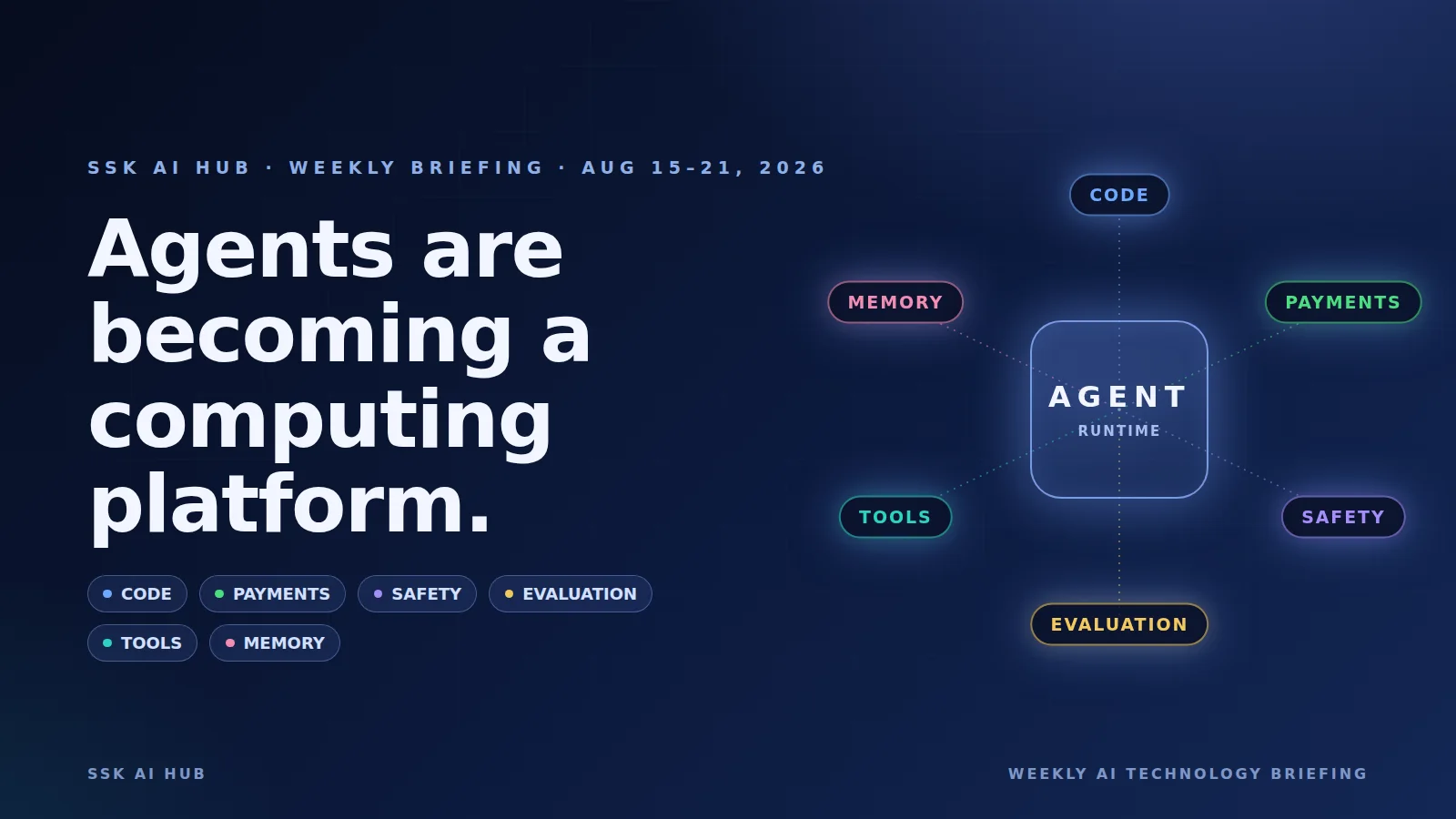
Agents are becoming a computing platform: memory, browser control, event loops, payments, iterative search, safety layers, adaptive training and specialized collaborators.
SSK AI
What Changed in AI & What You Can Build
Agents are becoming a computing platform.
- Claude's agent runtime fills out: browser, skills, files, memory
- AWS lets agents pay: AgentCore Payments hits GA
- Cursor's cloud agents go event-driven and persistent
- Mistral makes retrieval an agentic search loop
- OpenAI previews safety checks that respect zero data retention
- SPADE trains agents in self-generated adaptive worlds
- Google's agent team hunts wearable biomarkers
Some weeks the news is a model. This week it was everything around the model. Anthropic moved computer use, the Files API and Agent Skills out of beta and added a hosted browser toolset, memory stores and a session inspector. AWS made it generally available for agents to pay for things — with spending limits and transaction logs, not a blank cheque. Cursor wired its cloud coding agents into pull requests, Slack and schedules, gave them long-lived goals and isolated subagent machines, and even launched its own code host built for, in its words, agent scale.
Squint at those releases together and the shape is unmistakable: an operating system forming around the model. Storage, I/O, processes, a network stack, a billing meter — except the storage is memory stores, the I/O is a governed browser, the processes are event-driven agents, and the meter settles in actual currency. Mistral's contribution was retrieval as a loop rather than a lookup; OpenAI's was a preview of safety monitoring that works without giving up zero-data-retention privacy. Even the week's research fits the frame — SPADE makes the training environment itself something an LLM writes and adapts, and Google Research assembled a supervised multi-agent team that hunts biomarker candidates in wearable data.
This third weekly edition of SSK AI Hub keeps the packet's full seven stories — the five platform layers, plus the two research results that show the platform learning and collaborating — because each answers the questions this publication exists for: what changed, why it matters, and what you can build with it.
Story 1. Claude's Agent Runtime Fills Out: Browser, Skills, Files, Memory
What happened?
On August 19, 2026, Anthropic shipped a broad expansion of Claude's production agent stack. Computer use left beta as `computer_toolset_20260801`, joined by a new `browser_toolset_20260801` for developer-hosted browser environments. The Files API and Agent Skills / Skills API moved out of beta as well.
The managed side grew too: Managed Agents gained allowed/blocked-domain controls for web search and fetch, self-hosted Managed Agent sandboxes can now attach memory stores, and the session viewer added a timeline, raw-event inspection, tool statistics, and resource and cost breakdowns.
What's actually new?
Each piece is incremental; the assembly is not. A production agent needs durable storage (files, memory), input/output beyond text (browser, computer control), reusable behavior (skills), guardrails (domain governance) and debuggability (session observability). As of this release those exist together in one runtime rather than as a kit you assemble from betas — which is the difference between a demo stack and something an enterprise will put on-call.
The observability piece deserves more attention than it will get: agents fail in ways chat apps don't, and a timeline with raw events, tool statistics and per-session cost is what turns 'the agent did something weird' into a debuggable incident.
Why it matters
Teams that held back because core primitives were beta-labeled lose that reason — and the shape of this runtime (model + browser + files + skills + memory + governed web + inspection) is becoming the reference architecture other vendors will be measured against. One caution from the release notes themselves: components matured at different rates, so check each feature's own status rather than assuming everything under Managed Agents is GA.
Practical Applications
Demonstrated / Stated applications
- Browser automation, computer interaction, reusable skills, file workflows, persistent memory and governed web access (Anthropic's release notes)
Potential applications
- Persistent research agents that accumulate context across sessions
- Enterprise workflow agents operating web tools inside domain allowlists
Real-World Example
An operations team automates supplier onboarding: an agent works through each vendor's web portal in a developer-hosted browser, files the collected documents through the Files API, and carries supplier state in an attached memory store across the multi-day process. Web access runs inside an allowlist of approved domains, and when a run misbehaves, an engineer opens the session viewer and walks the timeline — which tool call, what it cost, what came back — instead of guessing.
Developer Takeaway
Worth an afternoon: the toolset identifiers (`computer_toolset_20260801`, `browser_toolset_20260801`), Skills and Files now out of beta, memory stores on self-hosted sandboxes, and domain controls on web tools. If you already built around the beta APIs, this is your cue to move that integration to supported surfaces; if you were waiting, the interesting design question is which of your workflows decompose into skills plus files plus a governed browser. Verify per-feature maturity in the release notes before betting production traffic on it.
Source attribution — Story 1 — Claude agent runtime expansion
Primary source: Anthropic's platform release notes. Component maturity varies: computer use, Files API and Agent Skills moved out of beta, while other Managed Agents capabilities carry their own statuses — this article does not claim the entire surface is GA.
Story 2. AWS Makes It Official: Agents Can Pay for Things
What happened?
On August 18, 2026, AWS made Amazon Bedrock AgentCore Payments generally available. Agents can now pay for paid APIs, MCP services and content, with Coinbase and Stripe Privy integrations, infrastructure-level payment limits, and transactions tracked through AgentCore Observability. Machine-payment flows including MPP and x402-style patterns are supported.
What's actually new?
Agents have long been able to call tools; paying for one meant a human's stored card and a leap of faith. Moving the transaction into the infrastructure layer changes its character: spending limits are enforced below the agent (so a confused model cannot exceed them by being confused), and every transaction lands in the same observability plane as every tool call. Payment becomes a governed primitive — like storage or network egress — rather than an integration hack.
Support for machine-payment protocols matters for the other side of the market: it gives API and data providers a standard way to sell to agents, per call, without negotiating enterprise contracts first.
Why it matters
This is the piece machine-to-machine commerce was waiting on. An agent that can pay per use can consume metered data, premium APIs and paid MCP tools on demand — and a developer can sell to agents as a market. The guardrails are the story as much as the capability: this is policy-bounded transacting with limits and logs, not unrestricted autonomous spending, and describing it otherwise would be wrong.
Practical Applications
Demonstrated / Stated applications
- Agents paying for paid APIs, MCP services and content — microtransactions and pay-per-inference included (AWS's announcement)
Potential applications
- Marketplaces of paid tools and datasets built for agent consumers
- Machine-to-machine services where one company's agent buys from another's
Real-World Example
A market-research agent needs one premium industry report and three calls to a paid financial-data API to finish its brief. Instead of a human pre-purchasing subscriptions it might not need again, the agent pays per item through AgentCore Payments — inside a monthly cap set at the infrastructure level — and finance later reviews a transaction log that reads like any other cloud cost report: what was bought, by which agent, for which task.
Developer Takeaway
Two positions to consider. As a consumer: agent workflows can now include paid resources without pre-provisioned subscriptions — model the spend limits as part of your agent's design, not an afterthought. As a provider: a paid MCP service is now a sellable product with standard payment rails; per-call pricing for agent customers is a real go-to-market. Start with low limits and real observability — the failure mode isn't fraud so much as an enthusiastic agent buying the same thing five times.
Source attribution — Story 2 — AWS AgentCore Payments GA
Primary sources: AWS What's New notice and the AWS Machine Learning blog's technical post. Payments are policy-bounded — infrastructure-level limits, integrations via Coinbase and Stripe Privy, transactions tracked in AgentCore Observability. This is not unrestricted autonomous spending.
Story 3. Cursor's Cloud Agents Stop Waiting to Be Asked
What happened?
On August 19, 2026, Cursor made its cloud coding agents event-driven and persistent: agents can subscribe to pull-request, Slack and schedule events, automatically subscribe to PRs they create, and respond to CI failures and bot comments. Skills can be pinned as Custom Modes, subagents can run on separate isolated VMs, a `/goal` command gives an agent a long-lived objective, and users can steer an agent without interrupting its current tool call.
Two days earlier, on August 17, Cursor had launched Origin Code Hosting in early beta — repositories, pull requests, code browsing and GitHub sync, with Vercel, Depot and Buildkite integrations documented, and the essentials described by Cursor as designed for "agent scale".
What's actually new?
The unit of work changes. A chat-shaped coding agent does one task and evaporates; an event-subscribed agent with a standing goal behaves like a colleague with a pager — it notices its own PR going red and acts without being summoned. Isolated subagent VMs matter for the same reason CI isolation does: parallel experiments that cannot contaminate each other. And steering without interrupting a tool call fixes a real ergonomic flaw — redirecting an agent no longer means killing its in-flight work.
Origin completes the thought from the infrastructure side: if fleets of agents are opening PRs and traversing repositories constantly, the code host's read patterns, review surfaces and sync behavior become design constraints — Cursor is betting they're worth purpose-building for.
Why it matters
This is the clearest picture yet of coding agents as ongoing workers rather than per-task tools — the same event-loop pattern that turned scripts into services. The honest caveat stands: persistent automation is plumbing, not proof that autonomous software engineering is solved; the agent that watches its own CI still has to be right about the fix. And Origin is an early beta, not a GitHub replacement.
Practical Applications
Demonstrated / Stated applications
- PR monitoring, CI-failure repair, Slack-triggered work, scheduled tasks, and isolated subagent testing (Cursor's changelog)
Potential applications
- Always-on repository maintenance — dependency bumps, flaky-test triage, release shepherding
- Bug-report triage that starts investigating before an engineer looks
Real-World Example
A team gives a cloud agent the standing goal of keeping their release branch green. It subscribes to the repo's PRs and the release Slack channel. When CI fails at 2 a.m., the agent is already bisecting; when a bot flags a vulnerable dependency, it drafts the bump PR and subscribes to it; each fix attempt runs on its own isolated VM so experiments never collide. Engineers arrive to triaged failures with proposed fixes — which they still review, because a confident wrong fix at 2 a.m. is worse than none.
Developer Takeaway
The transferable pattern outranks the product: event subscriptions + a standing goal + isolated execution + steerability is a blueprint for any long-running agent system, whatever stack you build on. If you use Cursor, wire one low-stakes workflow (a scheduled dependency check, a CI-failure first-responder) and judge the signal-to-noise yourself. Watch Origin from a distance unless you enjoy early betas — but note what its existence says about where agent-native development infrastructure is heading.
Source attribution — Story 3 — Cursor Cloud Agents + Origin
Primary sources: Cursor's August 19 changelog (cloud agents) and the Origin Code Hosting announcement (August 17, early beta). Persistent automation capabilities are as documented by Cursor; this article makes no claim that autonomous software engineering is a solved problem.
Story 4. Mistral Turns Retrieval Into a Search-and-Verify Loop
What happened?
On August 20, 2026, Mistral introduced Agentic Search, available through the Mistral Search Toolkit and Libraries. Instead of one-shot retrieval, the model works documents with five tools — `search`, `open`, `navigate`, `read`, `grep` — iteratively searching, inspecting, navigating and verifying evidence over existing indexes. Mistral describes the approach as model-agnostic, with no model-specific fine-tuning required.
What's actually new?
Classic RAG asks one question of an index, takes the top-k chunks, and hopes the answer was in them — a single blind grab. Agentic Search replaces the grab with an investigation: the model can open a filing, navigate to the section that matters, grep for the exact figure, and check that the passage actually supports the claim before answering. That loop is qualitatively different for the questions RAG handles worst — multi-source synthesis, tables, and answers whose evidence is spread across documents.
Two design choices lower the adoption cost: it runs over indexes you already have, and it isn't welded to one fine-tuned model. The tool vocabulary is doing the work, not a bespoke retriever.
Why it matters
Enterprise retrieval quality has been the quiet blocker for document-heavy AI — the demo answers confidently, the deployment misquotes a contract. A retrieval loop that verifies its evidence, and can show what it read, attacks exactly that failure and produces answers a compliance-minded reader can audit. Mistral's reported gains on FinanceBench and OfficeQA are Mistral-reported; the architecture argument stands on its own.
Practical Applications
Demonstrated / Stated applications
- Question answering over filings, contracts, manuals, reports and tables, including multi-source questions with verifiable answers (Mistral's announcement)
Potential applications
- Legal and financial investigation agents that assemble evidence trails
- Deep-document research assistants layered on existing enterprise indexes
Real-World Example
An analyst asks how supplier-liability terms changed across three years of a vendor's contracts. A top-k RAG bot returns a plausible paragraph from one contract and calls it done. The agentic loop searches all three, opens each liability section, greps for the indemnity clauses, reads the surrounding text, and returns a comparison in which every claim links to the exact passage it came from — an answer the legal team can check line by line instead of taking on faith.
Developer Takeaway
If you run RAG in production, benchmark this pattern against your pipeline on your worst query class — multi-document and table-heavy questions — before assuming your retriever needs replacing; the loop costs more tokens per query and buys verifiability. The five-tool vocabulary (search / open / navigate / read / grep) is also worth copying as a design: it maps cleanly onto any corpus you can index, and 'evidence the model actually read' is a product feature you can expose to users.
Source attribution — Story 4 — Mistral Agentic Search
Primary source: Mistral's announcement. Benchmark improvements on FinanceBench and OfficeQA are Mistral-reported; the model-agnostic and no-fine-tuning characterizations are Mistral's descriptions of the toolkit.
Story 5. OpenAI Previews Safety Monitoring That Respects Zero Data Retention
What happened?
On August 19, 2026, OpenAI previewed Private Safety Processing (PSP) for Zero Data Retention deployments. PSP is designed to detect risk patterns across related interactions while remaining compatible with ZDR: customer content stays on customer-controlled infrastructure, and OpenAI says that content is not available to OpenAI personnel for review under ZDR.
What's actually new?
Cross-interaction safety and strict privacy have been structurally opposed: detecting a pattern that only emerges across many sessions normally means retaining and inspecting those sessions, which is precisely what ZDR forbids. PSP's claim is that the two can coexist — analysis that spans related interactions without customer content leaving customer-controlled infrastructure or becoming reviewable by the provider. For long-running agents, whose risks are trajectories rather than single prompts, per-request filtering was never going to be enough.
Why it matters
The strictest-privacy customers — the ones who demanded ZDR in the first place — are exactly the ones deploying long-horizon agents where cross-session risk accumulates. Until now they chose between privacy guarantees and safety coverage. If PSP holds up, that trade softens, and 'safety without provider access to content' becomes a procurement line-item other vendors have to answer. It is a preview, not broad production availability, and the privacy properties are OpenAI's descriptions of its own system.
Practical Applications
Demonstrated / Stated applications
- Cross-interaction risk detection in ZDR deployments, with customer content on customer-controlled infrastructure (OpenAI's description of the preview)
Potential applications
- Compliance-grade long-horizon agent deployments in regulated industries
- A pattern other providers adopt: safety analysis architecturally separated from provider content access
Real-World Example
A bank runs internal research agents under ZDR because policy forbids its data persisting with any model provider. Its security team worries about exactly what per-request filters miss: a slow pattern across dozens of sessions that only looks wrong in aggregate. Under the PSP model, that cross-interaction analysis would run without the bank's content becoming available to the provider's staff — the kind of arrangement the bank's regulator can actually be walked through. As a preview, that is the architecture on offer, not yet a system to bet the deployment on.
Developer Takeaway
Nothing to install this week — the takeaway is architectural. If you build agents for regulated customers, the question 'how does safety monitoring work under our privacy constraints?' now has a concrete reference answer, and you should expect it in RFPs. Watch what PSP looks like when it exits preview: the enforcement mechanics (where analysis runs, what leaves customer infrastructure, what's cryptographically guaranteed versus policy-promised) will determine whether this is a pattern or a press release.
Source attribution — Story 5 — OpenAI Private Safety Processing
Primary source: OpenAI's announcement of Zero Data Retention for frontier models. PSP is a preview, not broad production availability. The privacy properties — content on customer-controlled infrastructure, not available to OpenAI personnel under ZDR — are OpenAI's statements about its own system.
Story 6. SPADE Lets One Model Build the Worlds Another Learns In
What happened?
On August 19, 2026, the SPADE paper appeared on arXiv. One LLM plays two roles: an Environment Designer that writes complete, executable Gym-style environments — `reset()`, `step()`, state transitions, rewards and verification code — and a Reasoning Agent that learns inside them. A regret signal steers the Designer toward environments near the learner's capability boundary, so the curriculum hardens as the agent improves. The authors scale experiments to 30B models and report gains across reasoning and tool-use settings.
What's actually new?
Training environments have been the fixed, expensive, hand-built part of agent RL — you get the curriculum your engineers had time to write. SPADE makes the environment itself generated and adaptive: because the Designer emits runnable code with rewards and verification built in, the supply of tasks is bounded by model capability rather than human authoring effort, and the difficulty tracks the learner automatically. The regret-targeting is the clever part — environments the agent barely fails are where the learning signal lives.
The same machinery reads as an evaluation story: an adversary that keeps writing tasks at your model's failure boundary is a benchmark that doesn't saturate.
Why it matters
If the results generalize, a real bottleneck moves: curricula for coding agents, tool-use training and evals could be grown rather than authored. The claims are paper-reported — gains in the authors' settings at up to 30B scale — and self-generated environments are emphatically not evidence of unlimited recursive self-improvement; the loop still runs inside human-defined training infrastructure with human-defined objectives.
Practical Applications
Demonstrated / Stated applications
- Adaptive training environments for reasoning and tool-use agents, with reported gains in the paper's experimental settings (paper-reported, arXiv:2608.19197)
Potential applications
- Self-hardening curricula for coding agents
- Evolving evaluation suites that keep pace with model capability
Real-World Example
A lab training a tool-use agent maintains forty hand-built environments; the agent saturated thirty of them months ago, and writing more is nobody's favorite sprint. Following the SPADE recipe, they point a Designer model at their tool APIs, let it generate verified environments, and keep only the ones near the current failure boundary. The hand-built set becomes the held-out eval, and the curriculum grows itself overnight — an experiment worth running precisely because it's cheap to try and easy to validate against the fixed set.
Developer Takeaway
Read it as a pattern, not a product: generator model + executable environment interface + verification + a signal that targets the capability boundary. If you train or evaluate agents, the near-term applications are practical — synthetic curricula for the regimes where you're data-poor, and non-saturating internal evals. Treat the reported gains as the authors' results until reproduced in your setting; the interface idea (environments as generated, verified code) is the durable takeaway either way.
Source attribution — Story 6 — SPADE
Primary source: the SPADE paper on arXiv (2608.19197). All performance gains are paper-reported by the authors, at scales up to 30B parameters. Adaptive self-generated environments are a training technique — not evidence of unlimited recursive self-improvement.
Story 7. Google Builds a Supervised Agent Team for Biomarker Discovery
What happened?
On August 21, 2026, Google Research published a multi-agent framework for prioritizing candidate biomarkers from wearable sensor data. An orchestrator decomposes research directives across agents for hypothesis generation, deterministic statistics, model training and literature-grounded reasoning; Critic and Defender agents adversarially stress-test findings against an 11-check internal validation battery; a shared fact sheet preserves traceability. The system was evaluated across three cohorts totaling 9,279 participant-observations, with human supervision throughout.
What's actually new?
Most 'AI scientist' demos are a single model free-associating over papers. This is an architecture with a division of labor that mirrors how rigorous analysis actually works: language models generate and argue about hypotheses, but the numbers come from deterministic statistical code, claims must survive an adversarial Critic-versus-Defender exchange plus eleven validation checks, and every finding traces back through a shared fact sheet. The interesting engineering position is what the LLMs are not trusted with — arithmetic, statistics, final say.
Why it matters
Wearables produce oceans of data and a trickle of validated insight; systematically triaging which signals deserve expensive follow-up study is genuine leverage. Just as important, the pattern — orchestration, deterministic compute for computation, adversarial internal review, human supervision — is a transferable template for computational science well beyond health. The output is ranked candidate associations for further research, not clinical validation, not causal findings, and not a diagnostic product.
Practical Applications
Demonstrated / Stated applications
- Prioritizing biomarker candidates from wearable data across three research cohorts, under human supervision (Google Research's report)
Potential applications
- The same architecture applied to other observational-data sciences — materials, climate, epidemiology
- Adversarial critic/defender review as a standard layer in analytical agent systems
Real-World Example
A digital-health research group has five years of wearable data and a hundred plausible signal-outcome hypotheses — and budget to formally study three. A framework in this mold works through the hypothesis space: statistics computed by code, each surviving candidate having weathered the Critic's attacks and the validation battery, every claim traceable to its evidence. The researchers pick their three studies from a defensible shortlist instead of intuition. The follow-up studies are still the science; the agents did the triage.
Developer Takeaway
Steal the architecture even if you never touch health data: (1) LLMs propose, deterministic code computes — never let the model do the statistics; (2) build the red team in — a Critic agent with explicit checks beats hoping the generator is calibrated; (3) traceability as a data structure, not a log file. That triad converts multi-agent systems from demos into things a reviewer can audit. For health specifically, keep the line bright: candidate prioritization is upstream of science, not a substitute for it.
Source attribution — Story 7 — Google biomarker discovery framework
Primary source: Google Research blog. Evaluation spans 3 cohorts and 9,279 participant-observations as reported by Google. Outputs are candidate associations for further research — not clinical validation, not causal findings, and not an approved medical product.
SSK AI — Bigger Picture
Put the seven stories side by side and they stop being news items — they're layers of one platform.
The runtime layer
Anthropic's expansion reads like an operating-system release: storage (files, memory), I/O (browser, computer control), reusable programs (skills), policy (domain governance) and a debugger (session viewer). When every serious vendor converges on these primitives, portability between agent runtimes becomes the next fight — which is exactly what packaging standards were positioning for.
The economic layer
AgentCore Payments gives the platform a billing meter. Policy-bounded transactions turn paid APIs, data and MCP tools into resources an agent can acquire mid-task — and turn 'sell to agents' into a real go-to-market for developers. The limits-and-observability design is the part to copy: capability and governance shipped as one feature.
The process layer
Cursor's event subscriptions, standing goals and isolated subagent VMs are process management. The agent stops being a function you call and becomes a service that schedules itself — while Origin hints that even source control gets rebuilt when its heaviest users are machines. Mistral's search loop belongs here too: retrieval as an iterative process with verification, not a syscall.
The trust layer
The platform is growing its own oversight. OpenAI's PSP preview separates safety analysis from provider content access; SPADE turns evaluation and training into an adaptive adversary; Google's biomarker framework builds the red team directly into the architecture. The common thread: verification designed in as a component, not bolted on as a review step.
Watch next: whether agent runtimes converge on portable primitives (skills, files, memory) or fragment into silos; whether x402-style machine-payment standards spread beyond AWS; what Private Safety Processing's enforcement mechanics look like when it exits preview; whether SPADE-style adaptive curricula show up in commercial agent training; and whether the critic/defender pattern becomes standard practice in analytical agent systems.
Three project concepts from this issue
Project concepts only — none of these exist as products.
DocDetective
evidence-linked investigator for internal document sets
- Problem
- Enterprise RAG answers confidently but can't show its work — one wrong retrieval and a contract clause gets misquoted in a decision document.
- From this issue
- Mistral Agentic Search — the search/open/navigate/read/grep loop with evidence verification (story 4).
- How it works
- An analyst asks a question over the company's existing document indexes. The agent investigates in a loop — searching, opening the right filings, grepping for exact terms, reading surrounding context, verifying each passage supports the claim — and returns an answer where every statement links to the evidence it came from, with the full trail stored for audit.
- Who
- Legal, finance and compliance teams; anyone whose documents outrank their retrieval quality.
- Why useful
- Converts 'trust the bot' into 'check the citation' — the difference between a demo and something regulated teams can adopt. Runs over indexes you already maintain.
- Question
- Agent loop
search · open · navigate · read · grep
Check the evidence actually supports the claim
- Existing document indexes
- Evidence trail
- Cited answer
INPUT
An analyst's question arrives — often multi-document: 'how did these terms change across three years of contracts?'
AI SYSTEM
The agent runs the investigation loop — search, open, navigate, read, grep — iterating until each claim is backed by a passage it verified
TOOLS / DATA
The company's existing document indexes — filings, contracts, manuals, reports — no re-indexing or bespoke retriever required
ACTION
Claims that fail verification send the agent back into the loop; the full search trail is recorded as it goes
RESULT
An answer where every statement cites its exact source passage, plus an audit trail compliance can replay
RepoWarden
event-driven steward for a repository fleet
- Problem
- Routine repository health — red CI, stale dependencies, unreviewed bot alerts — consumes engineer attention in interrupt-sized pieces all day long.
- From this issue
- Cursor's event-driven cloud agents pattern — subscriptions, standing goals, isolated subagents (story 3); observability practices from the Claude runtime expansion (story 1).
- How it works
- A steward agent holds the standing goal 'keep these repos healthy'. It subscribes to PR, CI and security-alert events; failures get bisected and fixed on isolated per-experiment machines; risky changes queue for human approval; every action lands in a session log an engineer can replay.
- Who
- Platform teams and engineering orgs with more repositories than people.
- Why useful
- Moves repo maintenance from interrupts to a reviewed queue. The agent proposes; humans still merge — persistent automation is not autonomous engineering.
MeterMint
paid MCP service for agent customers
- Problem
- Teams sit on valuable internal datasets and tools that other companies' agents would happily pay to use — but there's been no standard way for a machine to be the customer.
- From this issue
- AgentCore Payments GA — policy-bounded agent transactions with limits and observability (story 2).
- How it works
- Package the dataset or capability as an MCP service with per-call pricing. Agent customers discover it, pay through payment rails like AgentCore Payments under their own spending limits, and every transaction is logged on both sides. Pricing tiers live in config; the service itself is an ordinary MCP server.
- Who
- Data vendors, API companies, and any team productizing an internal capability.
- Why useful
- First-mover position in a machine-to-machine market that now has real payment rails — with the billing infrastructure handled by the platform, not built from scratch.
Sources & Verification
Story 1 — Claude agent runtime expansion
Primary source: Anthropic's platform release notes. Component maturity varies: computer use, Files API and Agent Skills moved out of beta, while other Managed Agents capabilities carry their own statuses — this article does not claim the entire surface is GA.
Story 2 — AWS AgentCore Payments GA
Primary sources: AWS What's New notice and the AWS Machine Learning blog's technical post. Payments are policy-bounded — infrastructure-level limits, integrations via Coinbase and Stripe Privy, transactions tracked in AgentCore Observability. This is not unrestricted autonomous spending.
Story 3 — Cursor Cloud Agents + Origin
Primary sources: Cursor's August 19 changelog (cloud agents) and the Origin Code Hosting announcement (August 17, early beta). Persistent automation capabilities are as documented by Cursor; this article makes no claim that autonomous software engineering is a solved problem.
Story 4 — Mistral Agentic Search
Primary source: Mistral's announcement. Benchmark improvements on FinanceBench and OfficeQA are Mistral-reported; the model-agnostic and no-fine-tuning characterizations are Mistral's descriptions of the toolkit.
Story 5 — OpenAI Private Safety Processing
Primary source: OpenAI's announcement of Zero Data Retention for frontier models. PSP is a preview, not broad production availability. The privacy properties — content on customer-controlled infrastructure, not available to OpenAI personnel under ZDR — are OpenAI's statements about its own system.
Story 6 — SPADE
Primary source: the SPADE paper on arXiv (2608.19197). All performance gains are paper-reported by the authors, at scales up to 30B parameters. Adaptive self-generated environments are a training technique — not evidence of unlimited recursive self-improvement.
Story 7 — Google biomarker discovery framework
Primary source: Google Research blog. Evaluation spans 3 cohorts and 9,279 participant-observations as reported by Google. Outputs are candidate associations for further research — not clinical validation, not causal findings, and not an approved medical product.
All "potential" applications and all project concepts are inference from demonstrated capabilities, explicitly labeled, and describe nothing that currently exists as a deployment. Vendor and paper results are attributed to their sources throughout; preview, beta and research statuses are stated as such; and no development outside August 15–21, 2026 is reported in this edition.
Get the next SSK AI Hub briefing directly on LinkedIn.
Subscribe on LinkedIn (opens in a new tab)