

SSK AI — What Changed in AI & What You Can Build | August 29, 2026
Vol. 1Weekly No. 4Covering August 22–28, 2026
AI is breaking out of the model: this week's progress was interfaces — to physical hardware, human speech, Earth-scale data, GPUs, production runtimes and trustworthy evaluation.
SSK AI
What Changed in AI & What You Can Build
AI is breaking out of the model and connecting to everything around it.
- Anthropic drafts an MCP for physical hardware
- Qwen opens a preview of its next architecture
- DeepMind pilots double-blind frontier evaluation
- Google automates Earth-scale predictive modeling
- Gemini 3.5 Transcribe upgrades speech interfaces
- CUDA Python 1.0 gives Python stable GPU APIs
- TensorRT Model Connect: checkpoint to native inference
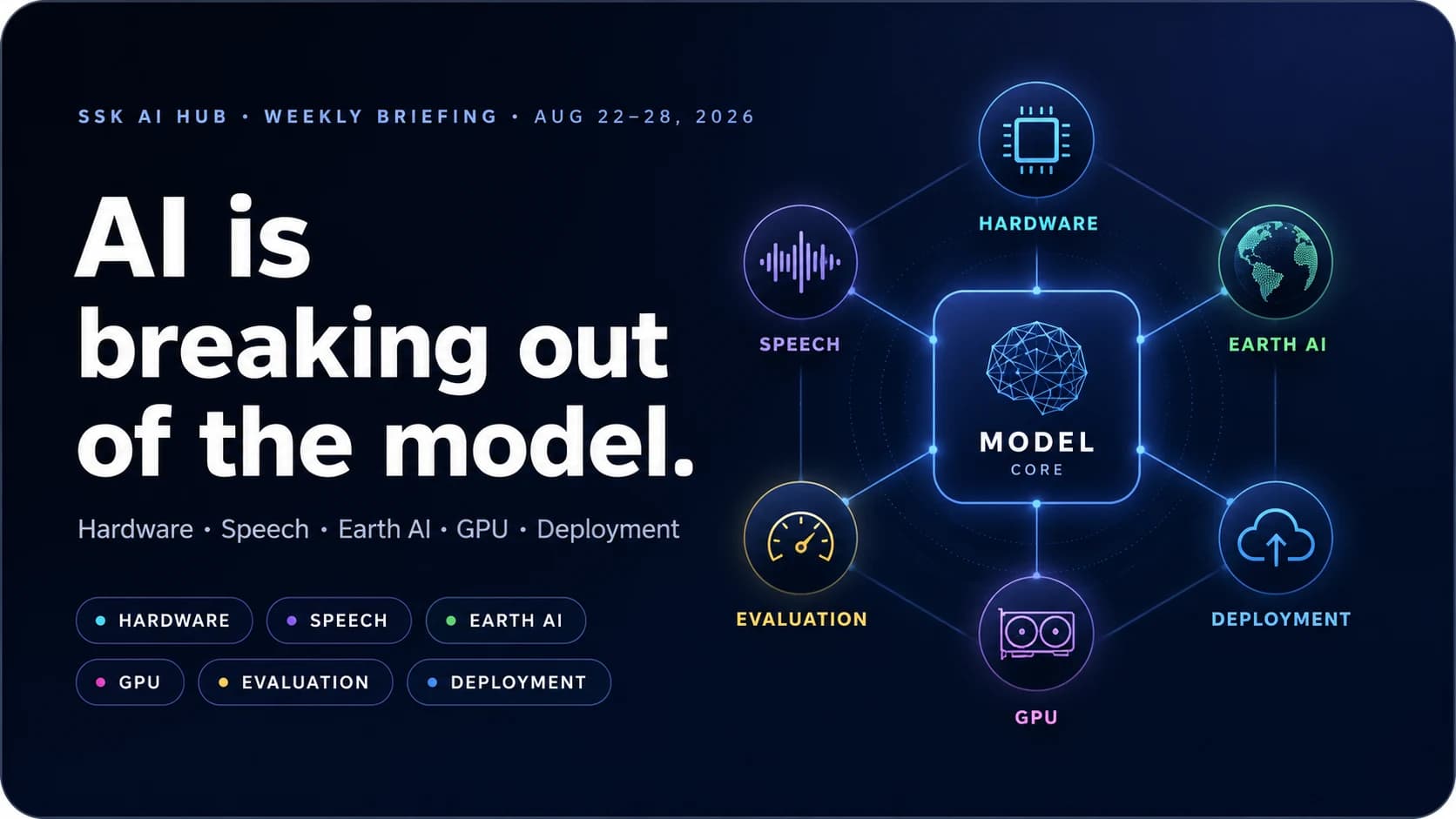
For four weeks this publication has watched the industry build outward from the model — into systems, into specialists, into platforms. This week the direction of travel became explicit: almost nothing important that happened between August 22 and 28 was a model getting smarter. It was models getting connected. Anthropic proposed a standard interface between AI and programmable physical hardware — lab instruments, robotics, quantum rigs — deliberately shaped like what MCP did for software tools. Google wired models into human speech with a transcription-native Gemini release, and into planetary data with an engine that automates Earth-scale geospatial modeling.
The connections run in less obvious directions too. Qwen opened the weights of a model it explicitly frames as a preview of its next architecture — connecting the open community to frontier design decisions before they harden. NVIDIA connected Python developers to the full CUDA platform under stable 1.0 APIs, and connected open checkpoints to production inference with a two-command path that can leave Python behind entirely. And DeepMind piloted what it describes as the first double-blind evaluation of a proprietary frontier model — connecting capability claims to tests the developer has never seen.
This fourth weekly edition keeps the packet's full seven stories. The two NVIDIA releases are not headline glamour, but they are the load-bearing kind of story SSK AI Hub exists to cover: the developer infrastructure that decides whether everything above it actually ships.
Story 1. Anthropic Drafts an MCP for the Physical World
What happened?
On August 27, 2026, Anthropic introduced the Model Hardware Standard (MHS) in research preview: a model-agnostic standard for operating programmable physical devices. Anthropic says it works with common protocols including MCP, and describes standard device primitives — reading and writing device state, and exposing a device's safety constraints and capabilities to the model operating it.
Early integrations span biotech, robotics and quantum-computing environments, with human-supervised hardware interaction as the demonstrated mode of use.
What's actually new?
Every AI-hardware project today builds a bespoke bridge: custom drivers, custom safety wrappers, custom capability descriptions, none of it portable. MHS proposes the missing abstraction — the same move MCP made for software tools, applied to machines. The detail that matters most is that safety constraints are part of the interface: a device declares what it can do and where its hard limits are, rather than trusting every model integration to rediscover them.
Model-agnosticism is the second signal. A standard only one vendor's models can speak is a moat; one any model can speak is infrastructure — and infrastructure is what Anthropic says it is aiming for.
Why it matters
If MHS attracts implementations, the cost of connecting AI to instruments, robots and lab equipment drops the way tool integration costs dropped after MCP — and a real physical-AI ecosystem becomes buildable by teams that don't own a robotics lab. The caution is built into the label: this is a research preview with early partners, not a universal production robotics standard, and today's demonstrated uses are human-supervised.
Practical Applications
Demonstrated / Stated applications
- Operating lab devices, orchestrating robotics-related equipment, and human-supervised hardware interaction (Anthropic's announcement)
Potential applications
- Autonomous experiment systems and lab-operations agents
- Manufacturing assistants and broader physical-world agents
Real-World Example
A biotech startup runs overnight assay preparation across a liquid handler, a plate reader and an incubator, each with its own vendor SDK. Against an MHS-style layer, each instrument would expose the same primitives — current state, allowed operations, hard safety limits — and the lab's scheduling agent would speak one interface instead of three, with a scientist approving the plan before anything moves. That is the shape of the demonstrated, supervised use today; the fully autonomous overnight lab remains the inferred future, not the current claim.
Developer Takeaway
Read the spec even if you never touch hardware — interface design for agents acting on the physical world (capability declaration, safety constraints as data, state read/write separation) is a pattern that will echo elsewhere. If you do work near lab automation or robotics: the leverage question is whether your device layer maps cleanly onto MHS primitives, and the experiment worth running during the preview is wrapping one instrument and putting a supervised agent in front of it.
Source attribution — Story 1 — Anthropic Model Hardware Standard
Primary source: Anthropic's announcement. MHS is a research preview; MCP compatibility and early biotech/robotics/quantum integrations are Anthropic-stated. It is not presented here as a universal production robotics standard.
Story 2. Qwen Opens the Weights on Its Next Architecture
What happened?
On August 26, 2026, Qwen released the open weights of Qwen3.8-Flash-Next — and explicitly framed it as an early preview of the Qwen4 architectural direction. Qwen says the changes span attention, residual structure, embeddings and optimization. The release is multimodal and MoE-based, with inference and community support documented in the model repository and ecosystem.
What's actually new?
Open releases usually trail a family's frontier: you get last generation's design, polished. Flash-Next inverts that — Qwen is shipping next generation's architectural ideas as open weights before Qwen4 itself exists publicly. For researchers, that means the interesting questions (how the revised attention behaves at long context, what the residual and embedding changes do to training dynamics) can be studied on real weights rather than reverse-engineered from a tech report. For the serving ecosystem, it's a head start: inference stacks can absorb the architecture before the flagship built on it arrives.
Why it matters
Architecture previews as open weights change the relationship between frontier labs and the open community — from consumers of hand-me-downs to early testers of the roadmap. Practically, teams get a current multimodal MoE model they can self-host and fine-tune today. Any performance comparisons circulating with the release are Qwen-attributed, and this article repeats none of them; the verifiable facts are the openness, the architecture framing and the modality.
Practical Applications
Demonstrated / Stated applications
- Open-weight experimentation, self-hosted inference and multimodal use (Qwen's release and repository)
Potential applications
- Architecture research on attention, residual and embedding changes ahead of Qwen4
- Self-hosted multimodal agents and inference-optimization work targeting the new design
Real-World Example
An inference-infrastructure team maintains a serving stack for open MoE models. When a next-generation architecture lands as a flagship, they usually scramble for weeks. With Flash-Next's weights public months ahead of that curve, they profile the revised attention pattern now, land kernel changes upstream, and by the time models built on this design ship in volume, their stack already serves them well — the same day-zero dynamic that has decided which serving frameworks matter.
Developer Takeaway
Two distinct reasons to pull the weights. As a builder: a current, open, multimodal MoE you can run and fine-tune on your own hardware. As a researcher or infra engineer: a preview of where a major model family's architecture is going — worth profiling even if you never deploy it, because its design choices are a bet on what Qwen4-era serving will require. Treat all benchmark claims as Qwen-reported and measure on your own workloads.
Source attribution — Story 2 — Qwen3.8-Flash-Next
Primary sources: Qwen's announcement and the model repository. The Qwen4-preview framing and the scope of architectural changes are Qwen's descriptions; benchmark comparisons stay Qwen-attributed and are not repeated here.
Story 3. DeepMind Pilots Frontier Evaluation Where the Developer Can't See the Test
What happened?
On August 27, 2026, Google DeepMind announced a pilot of what it describes as the first double-blind evaluation of a proprietary frontier-class AI model. The evaluation environment keeps test content hidden from the model developer, with the stated goal of reducing benchmark contamination and overfitting to known evaluations.
What's actually new?
Public benchmarks have a structural flaw: once a test is known, it leaks — into training data, into tuning choices, into the quiet gravitational pull of optimizing for what will be measured. Every reported score inherits that doubt. A double-blind setup attacks the flaw at its root: if the developer never sees the test content, the model cannot have been shaped to it, deliberately or accidentally. Medicine institutionalized blinding for exactly this reason; AI evaluation borrowing it is a sign the field is treating measurement as infrastructure rather than marketing.
Why it matters
Capability and safety claims increasingly drive procurement, policy and deployment decisions — and all of them are only as good as the evaluations underneath. A working double-blind protocol is the kind of primitive that frontier-model audits, safety cases and regulated assessments could be built on. Two framings to keep straight: this is an evaluation-methodology story, not a model launch, and it is a pilot — one run of a protocol, not an established institution.
Practical Applications
Demonstrated / Stated applications
- Reducing benchmark contamination and strengthening independent-style testing of a frontier model (DeepMind's description of the pilot)
Potential applications
- Third-party frontier-model audits and safety evaluations
- Regulated-assessment workflows where blinded testing is a requirement
Real-World Example
A safety institute wants to assess a frontier model's capability in a sensitive domain, but knows the vendor's reported numbers come from benchmarks the vendor could study. Under a double-blind protocol in this mold, the institute's test content stays sealed from the developer while the evaluation runs in a controlled environment — so the result measures the model, not the model's familiarity with the test. That is the workflow this pilot prototypes; standing institutions doing it routinely remain the inferred future.
Developer Takeaway
You won't run a double-blind frontier audit this quarter — but the contamination logic applies at every scale. If your team's eval suite is in your training data's reach (a repo the crawler sees, a public gist), your scores drift optimistic the same way. The cheap version of this week's lesson: keep a private, never-published holdout, rotate it, and treat any benchmark the model could have seen as a smoke test rather than a measurement. And watch whether blinded evaluation becomes something labs submit to routinely — that would change how much vendor scores mean.
Source attribution — Story 3 — DeepMind double-blind evaluation pilot
Primary source: Google DeepMind's blog post. "First double-blind evaluation of a proprietary frontier-class model" is DeepMind's characterization of its own pilot. This is an evaluation-methodology story — no new model is being launched or ranked here.
Story 4. Google Aims an Automation Engine at Earth-Scale Modeling
What happened?
On August 27, 2026, Google Research introduced the Planetary Prediction Engine (PPE), an experimental Earth AI capability that Google describes as automating major parts of geospatial modeling workflows — the pipeline from Earth data to trained predictive models. Example areas named include public health, food security, environmental risk and socioeconomic prediction.
What's actually new?
Geospatial modeling has been artisanal: each question — where will this disease risk concentrate, which regions face food insecurity — demands a bespoke pipeline of data wrangling, feature engineering and model training that takes a specialist team months. PPE's claim is that much of that pipeline can be automated into an agent-like workflow over Earth data. The shift echoes this month's larger pattern: not a better single model, but automation of the workflow around models — applied here to planetary-scale science.
Why it matters
The bottleneck in applied geospatial prediction has rarely been data — satellites produce oceans of it — but the scarce expertise to turn data into defensible models. If automation lowers that barrier, agencies and researchers without large ML teams get access to a class of modeling that was previously out of reach. PPE is an experimental research capability, not an autonomous production decision-maker, and nothing here should read as operational public-health or disaster tooling today.
Practical Applications
Demonstrated / Stated applications
- Automating data-to-model geospatial workflows and global modeling experiments (Google Research's description)
Potential applications
- Disaster-risk and disease-risk mapping tools built on automated pipelines
- Food-security modeling and environmental monitoring systems
Real-World Example
A public-health research group wants district-level early-warning models for a mosquito-borne disease across three countries — today a year-long project stitching climate rasters, population layers and case data into custom models. With a PPE-style automated workflow, the group would specify the prediction target and let the engine assemble candidate pipelines over Earth data, spending their scarce expertise on validating outputs instead of plumbing. The validation step stays human and essential: an experimental engine proposing models is the claim, not epidemiological ground truth.
Developer Takeaway
Watch-tier, but instructive. The design lesson generalizes: PPE treats an entire modeling discipline's workflow as an automatable pipeline — the same 'automate the workflow, not just the model call' pattern that showed up in agents and evals this month. If you work in geospatial or scientific ML, follow what Google exposes of PPE's interfaces; if automation like this matures, the valuable skill shifts from building pipelines to specifying problems and auditing automatically produced models.
Source attribution — Story 4 — Google Earth AI Planetary Prediction Engine
Primary source: Google Research blog. PPE is an experimental capability; workflow-automation scope and example domains are Google's descriptions. It is not an autonomous production decision-maker, and no operational deployment is claimed here.
Story 5. Gemini 3.5 Transcribe Treats Speech as an Interface, Not a Transcript
What happened?
On August 26, 2026, Google introduced Gemini 3.5 Transcribe, positioning it as intelligent transcription rather than basic automatic speech recognition. Google reports improvements in multilingual recognition, noise handling, formatting and latency, with developer access through the Gemini API and AI Studio plus enterprise platform surfaces.
What's actually new?
Classic ASR gives you words; everything that makes a transcript usable — punctuation, structure, speaker context, surviving a noisy room, staying coherent across languages — has traditionally been your problem, solved with a pipeline of post-processing. Positioning transcription as a Gemini-family model folds that intelligence into the transcription itself: output that arrives formatted and context-aware rather than as a raw token stream. The latency emphasis matters for the same reason — speech only becomes an interface when the loop is fast enough to interact with.
Why it matters
Speech is the input modality for meetings, support calls, clinics, cars and accessibility — and the gap between demo transcription and usable transcription has been the blocker in all of them. A developer-ready, API-accessible model aimed at that gap turns a hard preprocessing problem into a service call. Every quality claim here — multilingual, noise, formatting, latency — is Google-reported; benchmark it on your own audio before betting a product on it.
Practical Applications
Demonstrated / Stated applications
- Transcription, dictation and speech processing through the Gemini API and AI Studio (Google's announcement)
Potential applications
- Meeting agents and real-time support-call transcription
- Accessibility tools and voice-driven product interfaces
Real-World Example
A support-tooling startup transcribes customer calls in eight languages, currently through an ASR pipeline plus three post-processing stages that still garble names in noisy environments. Swapping the pipeline for an intelligent-transcription call would collapse those stages into one — formatted, multilingual output their downstream summarizer can consume directly. Whether accuracy on their call audio clears the bar is exactly what a week-long A/B against the existing pipeline would establish; Google's reported improvements set the expectation, not the verdict.
Developer Takeaway
The integration is deliberately boring — an API call in the Gemini surface you may already use — which is the point: speech input stops being a subsystem you maintain. Practical moves: benchmark against your current ASR pipeline on your worst audio (accents, crosstalk, noise), check the formatting behavior against what your downstream steps expect, and measure real latency from your infrastructure, not the marketing figure. If those hold, the interesting work moves up a level: what your product does with reliable speech, not how it gets it.
Source attribution — Story 5 — Gemini 3.5 Transcribe
Primary source: Google's announcement. All performance characterizations — multilingual recognition, noise handling, formatting, latency — are Google-reported. Access is via the Gemini API, AI Studio and enterprise platform surfaces as described by Google.
Story 6. CUDA Python Hits 1.0: Stable GPU APIs for the Language AI Runs On
What happened?
On August 25, 2026, NVIDIA released CUDA Python 1.0, establishing stable, semantically versioned Python APIs across CUDA functionality. NVIDIA highlights `cuda.core` and `cuda.compute`, continued Numba CUDA support, CUDA MLIR integration, and lower-level bindings for when abstractions run out.
What's actually new?
Python has been the language of AI while CUDA remained fundamentally a C++ platform with Python wrappers of varying blessing and stability — usable, but never a foundation you'd version a product against. A 1.0 with semantic versioning is a contract: the layered stack (high-level compute primitives down to raw bindings, with Numba and MLIR paths for kernel work) becomes something libraries can depend on without vendoring workarounds for every CUDA release. Boring on the surface; foundational in the way package managers and stable ABIs are foundational.
Why it matters
Most ML engineers hit a wall where PyTorch's abstractions end and a custom kernel begins — and crossing it has meant leaving Python. A stable Python-native path through the whole CUDA platform lowers that wall for the enormous population of Python-first developers, and gives library authors a dependable base for the GPU-accelerated tooling everything else imports. The practical effect compounds quietly: fewer C++ build systems in ML repos, more of the stack inspectable in one language.
Practical Applications
Demonstrated / Stated applications
- Python-native GPU development: kernels, compute primitives and lower-level CUDA access (NVIDIA's release)
Potential applications
- Custom inference kernels and GPU-side preprocessing written and maintained in Python
- Scientific-computing and ML-infrastructure libraries building on stable versioned APIs
Real-World Example
An ML team's tokenizer preprocessing is the CPU bottleneck in their serving path. The fix has been known for a year — a fused GPU kernel — but nobody wanted to own a C++ extension with its build matrix and bus-factor-of-one maintenance. With stable CUDA Python APIs, the kernel gets written with Numba against `cuda.core`, lives in the same repo as the Python service, is debugged by the same engineers, and survives CUDA upgrades behind a semver contract instead of breaking at each release.
Developer Takeaway
If you've deferred GPU work because it meant leaving Python, re-evaluate: start at `cuda.compute` primitives, drop to Numba-compiled kernels when you need custom logic, and reach for raw bindings only at the bottom. The 1.0 semver promise is the real feature — it's what makes CUDA Python a dependency you can put in a library's `pyproject.toml` rather than an experiment. Profile before and after; Python-native does not exempt you from measuring.
Source attribution — Story 6 — NVIDIA CUDA Python 1.0
Primary source: NVIDIA's developer blog. Component scope — cuda.core, cuda.compute, Numba CUDA support, CUDA MLIR integration and lower-level bindings — is as described in NVIDIA's release.
Story 7. TensorRT Model Connect Takes Open Checkpoints to Native Inference in Two Commands
What happened?
On August 28, 2026, NVIDIA introduced TensorRT Model Connect: an open collection of reference implementations for taking supported open models from checkpoint to native TensorRT inference in two commands. NVIDIA says the resulting runtime — with native C++ loading and TensorRT optimization — can avoid requiring PyTorch or Python in production entirely.
What's actually new?
The gap between an open checkpoint and a production inference system has been a specialist's project: export the graph, fight operator coverage, tune precision, build the engine, write the serving shim. Model Connect packages that path as maintained reference implementations per supported model — which changes who can do it. And dropping the Python runtime from production is more than a performance nicety: it removes an entire dependency surface from latency-critical, embedded and robotics deployments where a Python interpreter was always an awkward passenger.
Why it matters
Open weights are only as useful as your ability to run them well. Weeks like this one — where Qwen ships new open weights on Tuesday — make the deployment gap the real bottleneck, and a two-command path from checkpoint to optimized native inference narrows it for teams without a dedicated inference group. It pairs naturally with CUDA Python upstream: Python where you develop, no Python where you serve. Supported-model coverage is the thing to verify before planning around it.
Practical Applications
Demonstrated / Stated applications
- Checkpoint-to-inference packaging with native C++ loading and TensorRT optimization (NVIDIA's release)
Potential applications
- Edge, embedded and robotics deployments running open models without a Python runtime
- High-performance serving stacks built from reference implementations rather than bespoke exports
Real-World Example
A robotics company runs a perception model on embedded NVIDIA hardware. Today their path from a new open checkpoint to the robot is a three-week export-and-optimize project maintained by one overloaded engineer. With a Model Connect reference implementation for their model family, the checkpoint becomes a native TensorRT engine in two commands, and the on-robot runtime links a C++ library with no Python interpreter aboard — smaller image, fewer failure modes, faster iteration when a better checkpoint drops.
Developer Takeaway
If you deploy open models on NVIDIA hardware, this is worth an afternoon: check whether your model family is in the supported set, run the two commands against your checkpoint, and benchmark the resulting engine against your current serving path. The strategic read: NVIDIA is paving the road from the open-weights ecosystem to its inference stack — good for deployment friction, worth noticing as platform gravity. Keep your fallback path portable if that matters to you.
Source attribution — Story 7 — NVIDIA TensorRT Model Connect
Primary source: NVIDIA's developer blog. The two-command path and the claim that production runtimes can avoid PyTorch or Python are NVIDIA's descriptions; applicability depends on the supported-model list.
SSK AI — Bigger Picture
Seven stories, one preoccupation: the interfaces where models meet everything that isn't a model.
The hardware boundary
MHS is the week's biggest idea: make physical devices a standard target the way MCP made software tools one, with safety constraints declared in the interface itself. If it takes hold, 'physical AI' stops meaning a lab with a robotics team and starts meaning an integration task any agent developer can attempt — under human supervision, which is where the demonstrated uses deliberately stay.
Openness moves upstream
Qwen shipped tomorrow's architecture, not yesterday's model. Open weights as a preview channel for a frontier family's roadmap invert the usual lag — and give serving stacks, researchers and self-hosters a head start on the designs the next generation will demand.
Human and planetary I/O
Transcribe and PPE are the same story at two scales: connect models to streams they previously needed pipelines to touch. Speech arrives formatted and multilingual through one API; Earth data flows toward trained models through an automated workflow. In both, the pipeline work that consumed specialist time is what's being absorbed.
The trust and tooling substrate
Double-blind evaluation, CUDA Python 1.0 and Model Connect are infrastructure in three registers — trustworthy measurement, stable developer access to the GPU, and a paved road from checkpoint to production. None is glamorous; all three decide whether everything above them ships and whether its claims deserve belief.
Watch next: whether MHS attracts device-side implementations beyond Anthropic's early partners, and how it composes with MCP; which Flash-Next ideas survive into Qwen4; whether other labs submit models to double-blind evaluation; what interfaces Google exposes for the Planetary Prediction Engine; and how quickly CUDA Python and Model Connect surface inside the open-source serving stacks everyone actually uses.
Three project concepts from this issue
Project concepts only — none of these exist as products.
LabPilot
human-supervised orchestrator for programmable lab devices
- Problem
- Every AI-in-the-lab project rebuilds the same plumbing: custom drivers, custom safety wrappers, no portability between instruments or models.
- From this issue
- Anthropic's Model Hardware Standard — device primitives with declared safety constraints (story 1).
- How it works
- Instruments are wrapped behind MHS-style primitives: readable state, writable operations, declared capabilities and hard safety limits. A scientist approves an experiment plan; the orchestrating agent executes it across devices within their declared constraints, halting for human approval at irreversible steps, with every action logged against the plan.
- Who
- Biotech and materials labs, lab-automation vendors, research institutes.
- Why useful
- Turns AI-lab integration from a per-instrument custom project into configuration against a standard — while keeping humans on the approval path, which is where the demonstrated uses of MHS sit today. Built against a research preview; expect the interface to move.
Programmable lab devices execute within their declared limits
Irreversible steps stop for human approval
- Model-agnostic
- MCP-compatible (Anthropic-stated)
- Research preview
INPUT
A scientist writes and approves an experiment plan — targets, materials, device operations, stop conditions
AI SYSTEM
The orchestrating agent decomposes the plan into device operations, speaking one MHS-style interface instead of per-vendor SDKs
TOOLS / DATA
Instruments exposed through standard primitives: readable state, writable operations, declared capabilities and hard safety limits
ACTION
Routine steps execute within declared constraints; irreversible steps halt for human approval; every action is logged against the plan
RESULT
A completed run with a full device-level audit trail — and an integration that ports to the next instrument instead of starting over
PolyScribe
multilingual meeting-notes service on intelligent transcription
- Problem
- Teams that operate in several languages get meeting notes only for the meetings someone bothers to clean up — raw ASR output isn't worth reading.
- From this issue
- Gemini 3.5 Transcribe — formatted, multilingual, latency-focused transcription via API (story 5).
- How it works
- Calls route audio to the transcription API; formatted multilingual transcripts flow into a summarizer that produces decisions, owners and follow-ups in each participant's language. The formatting arriving clean from the model is what makes the downstream steps simple.
- Who
- Distributed teams, support organizations, accessibility-focused products.
- Why useful
- Collapses a multi-stage speech pipeline into one API call plus product logic. Validate Google's reported quality on your own accents and noise before trusting it with anything load-bearing.
NativeShip
Python-free edge serving for open checkpoints
- Problem
- Shipping open models to edge and embedded devices drags a Python runtime and a bespoke export project along with every checkpoint update.
- From this issue
- TensorRT Model Connect's two-command checkpoint-to-engine path (story 7), CUDA Python 1.0 for custom preprocessing kernels during development (story 6), and open weights like Qwen3.8-Flash-Next to ship (story 2).
- How it works
- A CI pipeline watches for new supported checkpoints, runs the Model Connect reference implementation to produce a native TensorRT engine, links it into a C++ runtime with no Python aboard, and promotes builds that pass an on-device benchmark suite. Custom pre/post-processing kernels are authored in Python with CUDA Python, then compiled into the pipeline.
- Who
- Robotics, embedded-AI and edge-deployment teams on NVIDIA hardware.
- Why useful
- Makes 'a better checkpoint dropped' a CI event instead of a three-week project — with a smaller, more auditable production runtime. Coverage depends on the supported-model list.
Sources & Verification
Story 1 — Anthropic Model Hardware Standard
Primary source: Anthropic's announcement. MHS is a research preview; MCP compatibility and early biotech/robotics/quantum integrations are Anthropic-stated. It is not presented here as a universal production robotics standard.
Story 2 — Qwen3.8-Flash-Next
Primary sources: Qwen's announcement and the model repository. The Qwen4-preview framing and the scope of architectural changes are Qwen's descriptions; benchmark comparisons stay Qwen-attributed and are not repeated here.
Story 3 — DeepMind double-blind evaluation pilot
Primary source: Google DeepMind's blog post. "First double-blind evaluation of a proprietary frontier-class model" is DeepMind's characterization of its own pilot. This is an evaluation-methodology story — no new model is being launched or ranked here.
Story 4 — Google Earth AI Planetary Prediction Engine
Primary source: Google Research blog. PPE is an experimental capability; workflow-automation scope and example domains are Google's descriptions. It is not an autonomous production decision-maker, and no operational deployment is claimed here.
Story 5 — Gemini 3.5 Transcribe
Primary source: Google's announcement. All performance characterizations — multilingual recognition, noise handling, formatting, latency — are Google-reported. Access is via the Gemini API, AI Studio and enterprise platform surfaces as described by Google.
Story 6 — NVIDIA CUDA Python 1.0
Primary source: NVIDIA's developer blog. Component scope — cuda.core, cuda.compute, Numba CUDA support, CUDA MLIR integration and lower-level bindings — is as described in NVIDIA's release.
Story 7 — NVIDIA TensorRT Model Connect
Primary source: NVIDIA's developer blog. The two-command path and the claim that production runtimes can avoid PyTorch or Python are NVIDIA's descriptions; applicability depends on the supported-model list.
All "potential" applications and all project concepts are inference from demonstrated capabilities, explicitly labeled, and describe nothing that currently exists as a deployment. Vendor and research claims are attributed to their sources throughout; research-preview, pilot and experimental statuses are stated as such; and no development outside August 22–28, 2026 is reported in this edition.
Get the next SSK AI Hub briefing directly on LinkedIn.
Subscribe on LinkedIn (opens in a new tab)