

AI Gets Cheaper, More Visual and More Accountable
Vol. 1Weekly No. 9Covering October 1–7, 2026
The practical advantage comes from choosing the right model, giving it useful evidence, defining its permissions and checking the finished work.
SSK AI
What Changed in AI & What You Can Build
AI gets cheaper, more visual and more accountable.
- GPT-6 and Intelligent UI: answers you can use
- Windows and NVIDIA: a platform for local agents
- Claude Haiku 5.5: more work for the small-model tier
- EmbeddingGemma 2: one local search space for all media
- Clef and Strands Decider: small models for bounded decisions
- Mistral Large 4: an API preview before the weights
- Reflection Beam: efficiency in the open-model race
- Nano Banana 2.1: fewer repair rounds for creative work
- Microsoft audio models: live transcripts, faster next steps
- Decagon Voice 3: talking and tool work together
- PACT: an agent must prove whose permission it carries
- OpenAI textGrain: provenance signals with limits
- OpenAI mathematics: publishing results starts the scrutiny
- OpenAI and Ironclad: score the finished workflow's rules
- Biohub expands the data foundation for predictive biology

October opened with a wide range of useful changes: more visual answers in ChatGPT, smaller models for everyday work, new open-weight previews, local-agent infrastructure, better retrieval and voice systems. Alongside those launches, mathematical artifacts and a major biology-data commitment put scientific evidence back in the spotlight.
Our view of this week is that the practical advantage comes from choosing the right model, giving it useful evidence, defining its permissions and checking the finished work. A lower token price helps. An available tool helps. Neither alone establishes that a workflow is reliable.
This edition selects 15 main stories and six shorter briefs from announcements dated October 1–7. Facts link to primary sources; sections labeled SSK AI Hub analysis and proposed examples are our interpretation. Source review took place on the evening of October 7 in America/Chicago, with a final pass over the primary sources before publication. Availability and prices reflect the reviewed announcements. Original AI-generated artwork is conceptual, including its interface motifs, stamps and decorative equations.
This is October's first weekly briefing. September is summarized in the September 2026 Month in Review, and the previous weekly windows are covered in the September 22–28 and September 15–21 editions. Every weekly and monthly briefing is collected on the SSK AI Tech News desk.
The week at a glance
| Development | Announcement date | Release status |
|---|---|---|
| GPT-6 and Intelligent UI | October 7 | Rollout announced; plan and workspace conditions apply |
| Windows and NVIDIA local agents | October 7 | MXC generally available; hardware preorders and later delivery |
| Claude Haiku 5.5 | October 7 | Available; related subscriber credits rolling out |
| EmbeddingGemma 2 | October 6 | Weights available; platform integrations vary |
| Clef and Strands Decider | October 1 | Released with public weights and code |
| Mistral Large 4 | October 6 | Public API preview; weights planned for month-end |
| Reflection Beam | October 5 | Announced; early-access sign-up; weights pending |
| Nano Banana 2.1 | October 6 | Documented release; verify access in the target product |
| Microsoft audio models | October 1 | Launch announced through supported platforms |
| Decagon Voice 3 | October 1 | Enterprise product announcement; demo-led access |
| PACT agent consent protocol | October 1 and 6 | Open specification announced; adoption still developing |
| OpenAI textGrain | October 5 | API opt-in; EU product rollout planned; detector restricted |
| OpenAI mathematics release | October 6 | Manuscripts public; originating model unreleased |
| OpenAI and Ironclad | October 6 | Research collaboration and evaluation; not universal automation |
| Biohub virtual biology | October 7 | Commitment and collaboration; future data and model outcomes |
Story 1. GPT-6 and Intelligent UI: the answer becomes something you can use
What happened
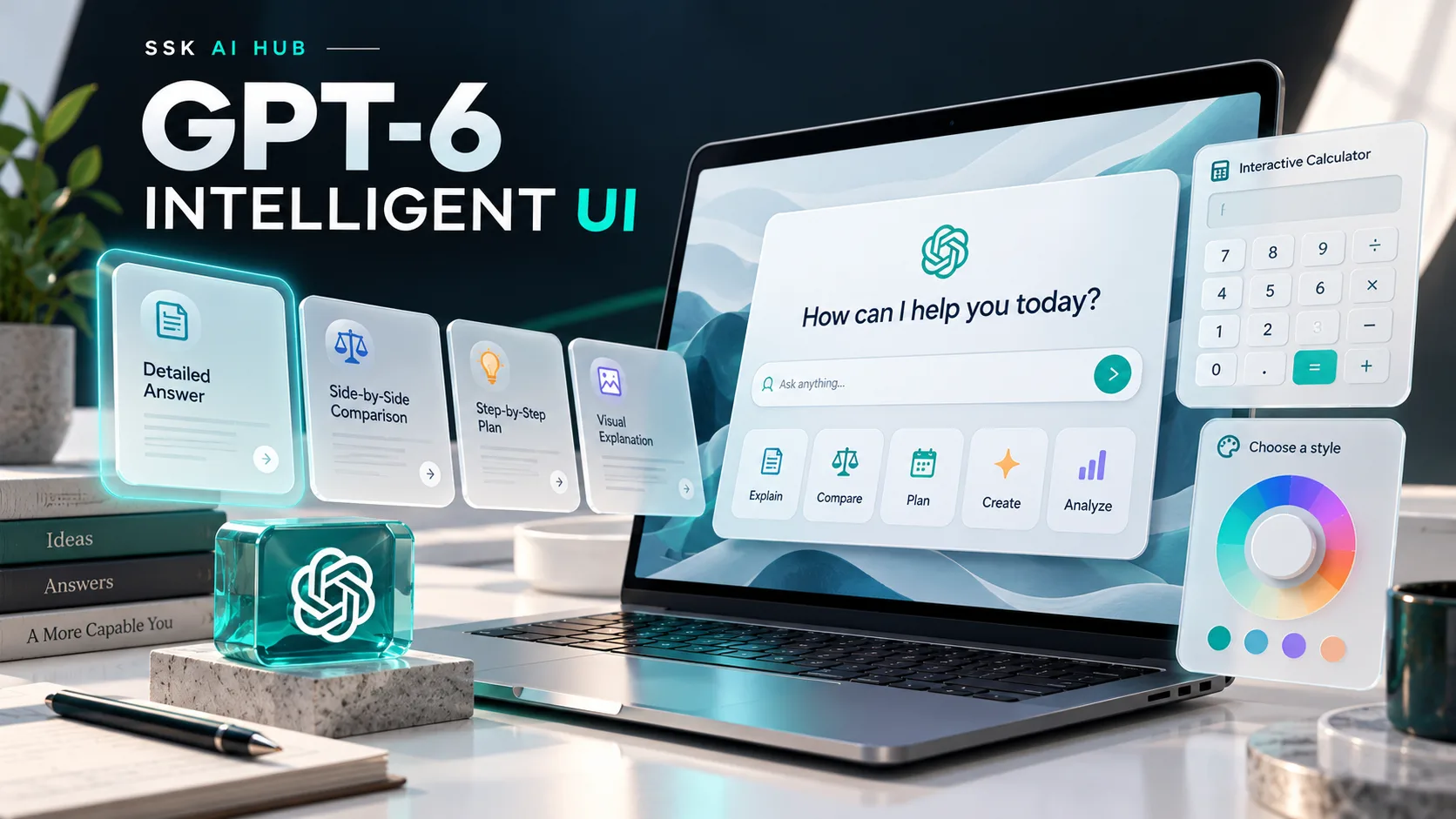
OpenAI announced GPT-6 with Intelligent UI in ChatGPT on October 7. Responses can combine prose with visuals and interactive elements, including charts, forms and small tools. The model can also start answering while further reasoning or tool work continues. The Chat rollout starts with Plus, Pro, Business and Enterprise, with Free and Go scheduled to follow on October 8. Paid tiers use a conversational GPT-6 Sol; Free and Go use GPT-6 Luna. This announcement does not change the models powering Work and Codex. OpenAI announcement.
Why it matters — SSK AI Hub analysis
A useful interface can remove work from the reader. A static explanation of a loan requires someone to repeat calculations for every new input; a calculator lets them explore those inputs directly. But an interface can also make an incorrect assumption harder to notice. The product test is whether people understand the result and can inspect what changed when they interacted with it.
Stated and proposed applications
Demonstrated / Stated applications
- Answers that combine prose with charts, forms and small tools, and can begin while reasoning or tool work continues (OpenAI's announcement; rollout by plan and workspace)
Potential applications
- A shared-grocery bill tool with named participants, item ownership and tax allocation — a proposed evaluation, not a tested result
Practical example — a proposed workflow
Ask for a shared-grocery bill tool with named participants, item ownership and tax allocation. Change one item from “everyone” to two people and inspect whether every total updates consistently. The acceptance check is simple: the participant totals must still equal the receipt total, and the tax rule must be visible. This is a proposed evaluation, not a tested result from the release.
Developer takeaway
Check the calculations, labels, keyboard access and mobile behavior of generated interfaces. A polished interactive answer still needs a correct underlying model of the task.
Source attribution — Story 1 — OpenAI GPT-6 and Intelligent UI
Primary source: OpenAI's October 7 announcement. This is a Chat experience rollout, starting with paid plans and following on October 8 for Free and Go; it is not a new Work or Codex model release, and not every account received access immediately.
Story 2. Windows and NVIDIA: local agents get a platform around them
What happened
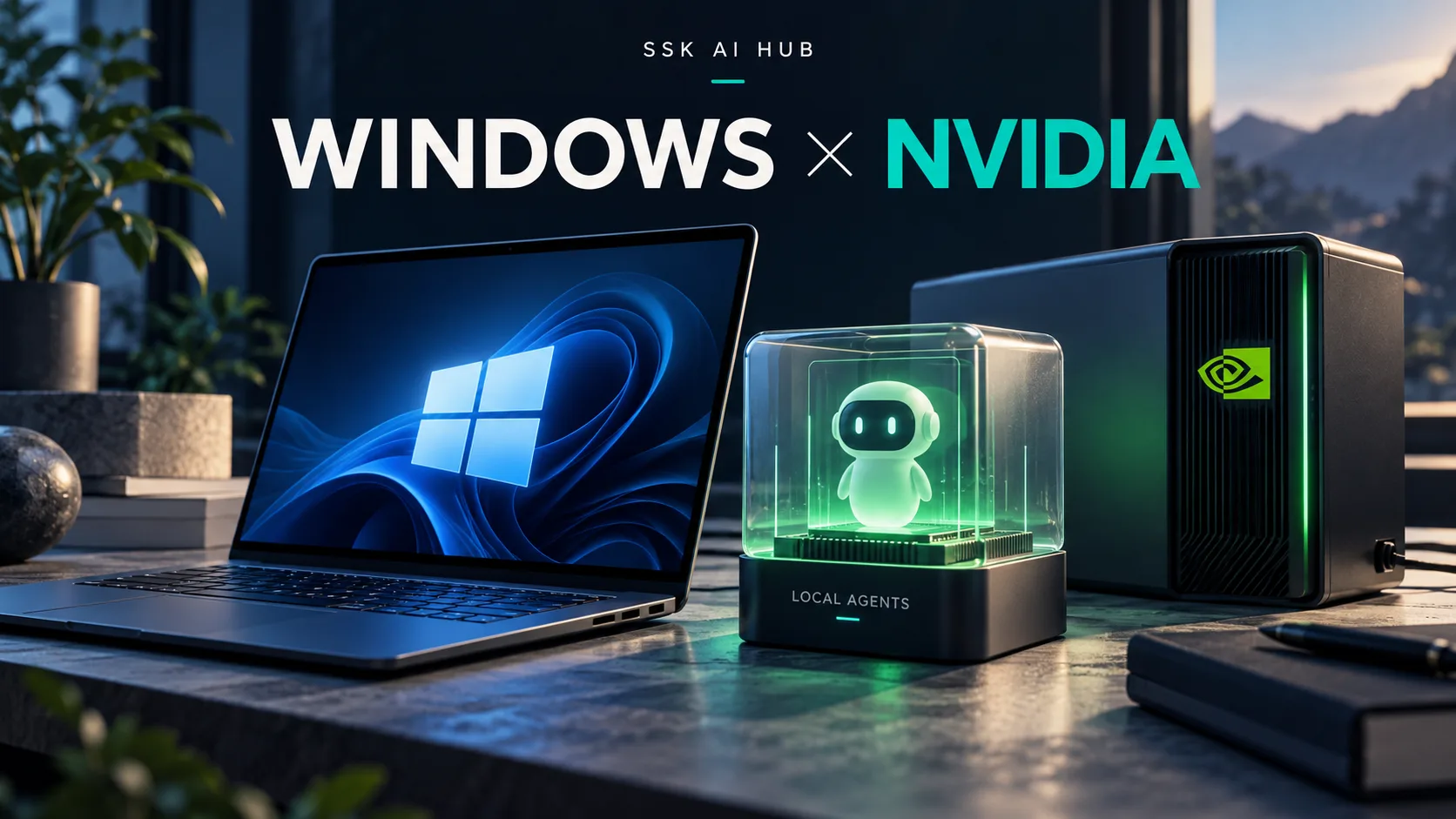
Microsoft announced general availability of Microsoft Execution Containers (MXC) on Windows 11, with runtime controls over agent file and network access. It also described local deployment of MAI-Code-1.1-Flash using 3-bit precision. Microsoft announcement.
NVIDIA and Microsoft introduced RTX Spark systems for local AI. Laptop preorders opened October 7, with availability beginning October 16; compact desktops follow in November. NVIDIA lists up to 128 GB unified memory. These are announced hardware capabilities and delivery plans, rather than independent measurements. NVIDIA announcement.
Why it matters — SSK AI Hub analysis
A local agent needs more than enough memory to load a model. It needs a place to run, boundaries on access and a way to identify its actions. Hybrid systems also need an explicit rule for deciding when work stays local and when it goes to a cloud model. Hardware capacity, sustained speed and the total operating cost are different questions.
Stated and proposed applications
Demonstrated / Stated applications
- Microsoft Execution Containers on Windows 11 with runtime controls over agent file and network access, generally available (Microsoft)
- RTX Spark laptops (preorders October 7, availability from October 16) and compact desktops in November, with up to 128 GB unified memory (NVIDIA and Microsoft; announced specifications and delivery plans)
Potential applications
- A local agent that indexes an approved repository and drafts a patch, routing an unusually difficult debugging task to a cloud service — a proposed workflow
Practical example — a proposed workflow
A developer could let a local agent index an approved repository and draft a patch, then route an unusually difficult debugging task to a cloud service. File permissions would constrain the local workspace; the cloud step would receive only the approved context. Test the local and cloud steps separately, including what happens when network access is unavailable.
Developer takeaway
Use your actual repository, context length and concurrency when assessing a local system. Compare accepted tasks per hour, memory use and electricity with the cloud bill; parameter capacity alone cannot answer that comparison.
Source attribution — Story 2 — Microsoft Windows and NVIDIA RTX Spark
Primary sources: Microsoft's Windows announcement and NVIDIA's RTX Spark announcement, both October 7. Windows containers, local model deployment, laptop preorders and desktop delivery are separate status items. Hardware specifications are announced capabilities, not independently measured speedups.
Models, cost and local retrieval
Story 3. Claude Haiku 5.5: more work can move to the small-model tier

What happened
Anthropic released Claude Haiku 5.5 for short, high-volume tasks and subagent work, with adjustable effort. For prompts up to 100,000 tokens, listed prices are $0.10 per million input tokens and $0.50 per million output tokens; longer prompts use higher rates. The API identifier is claude-haiku-5-5. Anthropic also cut Sonnet 5.5 cache reads from $0.20 to $0.10 per million tokens and announced monthly API credits for Max and Team subscribers. Its estimated workload savings are vendor claims, not guaranteed savings for every application. Anthropic launch.
Why it matters — SSK AI Hub analysis
The useful cost question is how much it takes to finish an accepted task. A cheap request that repeatedly needs correction may lose its advantage. A small model is particularly interesting when the job has a narrow output and a clear check: extract a record, classify a message or summarize a known document. More complicated work can still need a stronger model.
Stated and proposed applications
Demonstrated / Stated applications
- Short, high-volume tasks and subagent work with adjustable effort, priced by prompt-length tier (Anthropic; savings estimates are vendor claims)
Potential applications
- Extracting source dates and short summaries in a weekly-report workflow, with a larger model writing the final synthesis — a proposed workflow
Practical example — a proposed workflow
In a weekly-report workflow, try the small model for extracting source dates and preparing short summaries. Let a larger model compare conflicting reports and write the final synthesis. Record rejected extractions and repeated calls as part of the bill. For an illustrative request below the prompt threshold with 1,000 input and 200 output tokens, base token charges would be $0.0002, excluding caching, other services and retries.
Developer takeaway
Evaluate a bounded task suite before changing the default model. Keep quality, latency, prompt-length pricing and escalation cost in the same report.
Source attribution — Story 3 — Anthropic Claude Haiku 5.5
Primary source: Anthropic's launch page and price table, October 7. The prompt-length price tiers matter: the listed rates apply to prompts up to 100,000 tokens, and longer prompts cost more. The illustrative $0.0002 charge excludes caching, other services and retries. Subscriber API credits and token pricing are separate products, and Anthropic's workload-savings estimates are its own claims. The Sonnet 5.5 cache-read price cut is an October 7 update; Sonnet 5.5 itself was announced September 28.
Story 4. EmbeddingGemma 2: one local search space for different media
What happened
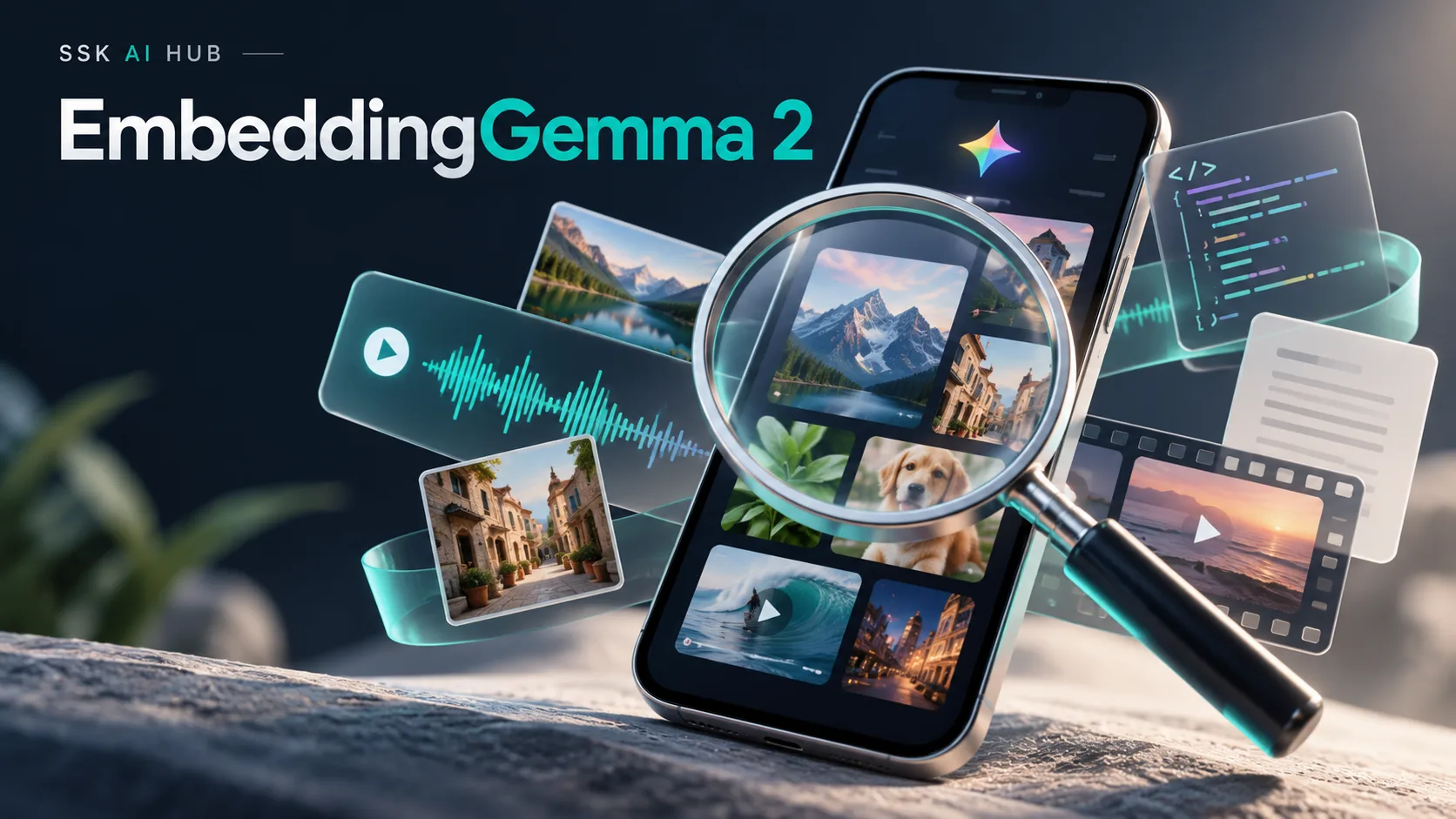
Google released EmbeddingGemma 2, a 740-million-parameter multimodal embedding model under Apache 2.0. It maps text, code, images, video and audio into a shared representation. Its modular design supports text-only workloads, with optional visual and audio encoders. Output vectors can be shortened from 768 dimensions to 512, 256 or 128 through Matryoshka Representation Learning. Google positions it for on-device retrieval and publishes device-specific memory figures; those figures should not be assumed for every runtime. Google announcement.
Why it matters — SSK AI Hub analysis
Embeddings are numerical representations used to retrieve similar content. Sharing a space across media makes it possible to search a visual or audio collection using a text query. This is the retrieval part of an application: finding relevant material. A separate step still has to decide what the retrieved material establishes and whether it supports an answer.
Stated and proposed applications
Demonstrated / Stated applications
- On-device retrieval across text, code, images, video and audio with shortenable vectors, under Apache 2.0 (Google)
Potential applications
- A local index of approved lecture notes, slide images and recording segments, showing the page or timestamp for each match — a proposed workflow
Practical example — a proposed workflow
A student could index approved lecture notes, slide images and short recording segments locally. A query such as “the example about a misleading evaluation split” could retrieve several kinds of evidence. The interface should show the page or timestamp and let the student open the original. Compare the first five matches with manually labeled examples.
Developer takeaway
Choose vector length using retrieval quality on your own collection. A smaller index is useful only if it retains the evidence your users need.
Source attribution — Story 4 — Google EmbeddingGemma 2
Primary source: Google's October 6 launch. Embedding models retrieve material; they do not establish that an answer is supported. Google's memory estimates depend on encoders, quantization and runtime.
Story 5. Clef and Strands Decider: small models make bounded decisions
What happened
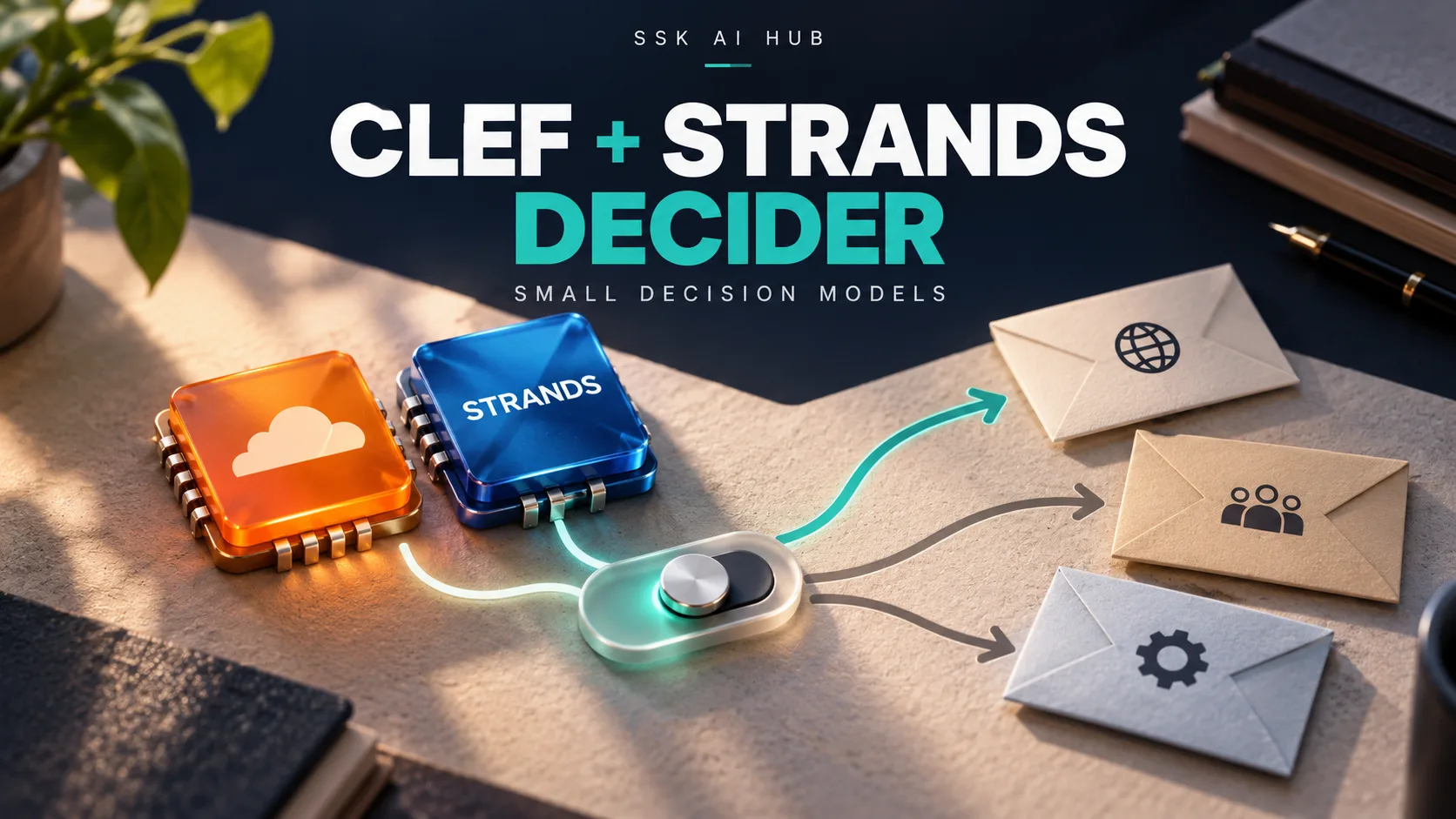
Cloudflare introduced Clef and Clef-flash, decision models on Workers AI with Apache 2.0 weights. They return structured classifications with probabilities and can handle visual inputs. Cloudflare also announced a reinforcement-learning fine-tuning platform. Cloudflare launch.
The Strands team released Strands Decider 2B with model weights, training data and scripts. Its intended applications include routing, tool selection and guardrails. The launch demonstrates checking whether a proposed tool call is grounded in the user's information. Strands launch.
Why it matters — SSK AI Hub analysis
Many agent steps ask a bounded question: which queue should handle this request, is a required field present, or should this task escalate? These steps deserve a different evaluation from open-ended writing. A probability can help set a routing threshold, but its meaning must be checked on the target data. Deterministic permission rules should still be enforced by code.
Stated and proposed applications
Demonstrated / Stated applications
- Structured classifications with probabilities, including visual inputs, on Workers AI (Cloudflare)
- Routing, tool selection and guardrails, including checking whether a proposed tool call is grounded in the user's information (Strands launch)
Potential applications
- A support assistant that routes confident billing and technical cases and defers ambiguous ones — a proposed comparison against simple rules
Practical example — a proposed workflow
For a support assistant, compare a decision model with simple rules on a labeled set of billing, technical and ambiguous messages. Route confident cases, defer ambiguous cases and record each decision. Include unfamiliar requests and messages containing instructions that conflict with the application's rules. Assess the tradeoff between coverage and wrong routing.
Developer takeaway
Calibrate the threshold on development data and evaluate it on held-out cases. Report the errors among accepted decisions, rather than only overall classification accuracy.
Source attribution — Story 5 — Cloudflare Clef and Strands Decider
Primary sources: Cloudflare's and Strands' October 1 launches. Decision-model probabilities require calibration on the target workload, and permission checks belong in the service irrespective of a classifier result.
Story 6. Mistral Large 4: an API preview ahead of the weight release

What happened
Mistral opened a public preview of Mistral Large 4, nicknamed “Le Chonk.” Its official announcement describes a natively multimodal mixture-of-experts model with about one trillion total parameters and 52 billion active parameters. The preview API is available through Mistral Studio; weights are planned for the end of October while red-teaming continues. Published API rates are $1.36 per million input tokens and $4.18 per million output tokens. Mistral's benchmark leadership statements remain attributed claims. Mistral announcement.
A final check of Mistral's pages before publication found its model documentation giving 52 billion active and 1.05 trillion total parameters, while some other Mistral pages and early coverage cited 49 billion active. Mistral model documentation.
Why it matters — SSK AI Hub analysis
Open-weight plans and available open weights are separate milestones. An API preview can support an early evaluation, but it does not yet establish the final artifact, license conditions or self-hosting requirements. Mixture-of-experts models also have a gap between the parameters used for a token and the total weights that a serving system must accommodate.
Stated and proposed applications
Demonstrated / Stated applications
- A natively multimodal model available through a public preview API on Mistral Studio (Mistral; weights planned for the end of October)
Potential applications
- A document-analysis trial with technical drawings and scanned tables, scored on both answers and evidence location — a proposed evaluation
Practical example — a proposed workflow
Prepare a small document-analysis trial with technical drawings, scanned tables and questions whose answers have known page locations. Compare the preview with your existing model on both answer correctness and evidence location. Keep the evaluation portable so it can be rerun against a downloadable release if and when that arrives.
Developer takeaway
Pin the API version and preserve input artifacts. Wait for the released weights, license and deployment documentation before treating a self-hosted configuration as available.
Source attribution — Story 6 — Mistral Large 4
Primary sources: Mistral's October 6 announcement and model documentation. Mistral Large 4 is a preview with a pending weight release — do not call its weights downloadable this week or infer a self-hosting license before it is released. Benchmark leadership statements are Mistral's claims. Mistral's pages differ on the active-parameter count (52 billion in the documentation and announcement; 49 billion on some other pages and in early coverage).
Story 7. Reflection Beam: efficiency is part of the open-model competition

What happened
Reflection announced Beam, a text-only sparse mixture-of-experts model with 501 billion total parameters and 23 billion active parameters, aimed at coding, reasoning and agent workflows. The company reports large-scale reinforcement learning and lower inference compute than selected comparison models. Beam remained in final red-teaming and evaluation at announcement; weights, a technical report, a model card and developer artifacts were promised later in October. Reflection announcement.
Why it matters — SSK AI Hub analysis
Efficiency can make repeated reasoning economically useful, but comparison conditions matter. Hardware, reasoning budgets, context length and accepted-output quality can all change the conclusion. Active parameters do not by themselves specify the memory needed to serve the full model, so “23 billion active” should not be treated as a laptop requirement.
Stated and proposed applications
Demonstrated / Stated applications
- Coding, reasoning and agent workflows, with lower inference compute than selected comparison models (Reflection's claims; weights and technical report pending)
Potential applications
- A future comparison set of repository fixes with executable checks, measuring tokens, time and cost per accepted fix — a proposed harness
Practical example — a proposed workflow
Build a future comparison set of repository fixes with executable checks. Preserve the exact issue, starting commit and acceptance tests. Once access and artifacts are available, measure the total tokens, elapsed time and infrastructure expense for each accepted fix. Until then, prepare the harness rather than inventing a local deployment recipe.
Developer takeaway
Keep a status field beside every model in your evaluation tracker. An announcement belongs on a watchlist until you can inspect access terms and run the comparison.
Source attribution — Story 7 — Reflection Beam
Primary source: Reflection's October 5 announcement. Beam's weights are pending; do not call them downloadable this week or infer a self-hosting license before release. Efficiency comparisons are Reflection's own, against selected models.
Story 8. Nano Banana 2.1: creative workflows need fewer repair rounds

What happened
Google published Nano Banana 2.1 documentation and its model card on October 6. The API model is gemini-nano-banana-2.1. Google describes improvements to image quality, text rendering and consistency across edits, with support for up to 14 reference images. The documentation lists configurable thinking levels and search grounding. The model card identifies Gemini 3.6 Flash as its base and lists distribution through products including the Gemini app, AI Studio, the API and Flow. Developer documentation, model card.
Why it matters — SSK AI Hub analysis
For creative production, the meaningful unit is a finished asset that meets the brief. A cheaper first image may still need several edits for text, proportions or consistency. Evaluation should include those repair rounds and the time needed to check the final result. Attractive generated infographics also need separate factual verification.
Stated and proposed applications
Demonstrated / Stated applications
- Improved image quality, text rendering and edit consistency, with up to 14 reference images (Google's documentation and model card)
Potential applications
- A three-asset campaign from one approved product reference and exact headline, counting corrections before acceptance — a proposed trial
Practical example — a proposed workflow
Try a three-asset campaign based on the same approved product reference and exact headline. Give each asset a different composition, then assess whether the product, colors and wording stay consistent. Count corrections before accepting the set. Use software-rendered charts whenever a visual needs exact measurements.
Developer takeaway
Check the current product-specific limits. The API documentation and model card differ on some context and output details, so this briefing avoids presenting one universal token-limit figure.
Source attribution — Story 8 — Google Nano Banana 2.1
Primary sources: Google's API documentation and DeepMind model card, October 6. The documentation and model card differ on context and output specifications, so this edition omits a universal token-limit claim; use the documentation for the exact endpoint you implement against.
Story 9. Microsoft audio models: live transcripts can start the next step sooner
What happened
Microsoft introduced MAI-Transcribe-2-Streaming alongside MAI-Voice-2.1 and MAI-Voice-2.1-Flash. The streaming transcription model supports 60 languages and revises partial transcripts as more audio arrives. Its introductory price is $0.54 per audio hour through the end of 2026. The two voice models support 23 languages; listed prices are $22 and $15 per million characters respectively. The launch describes access through Microsoft Foundry and other integrations, with LiveKit marked as coming soon. Microsoft AI announcement.
Why it matters — SSK AI Hub analysis
A partial transcript is an early hypothesis. It can make captions feel responsive or let an agent prepare a lookup, but later words can change the meaning. Application design needs a distinction between tentative display, stable text and permission to perform an action. Faster speech recognition does not remove that distinction.
Stated and proposed applications
Demonstrated / Stated applications
- Streaming transcription in 60 languages that revises partial transcripts, plus voice models in 23 languages, through Microsoft Foundry and other integrations (Microsoft; LiveKit marked as coming soon)
Potential applications
- A meeting assistant that shows tentative captions but waits for stable segments before extracting commitments — a proposed design
Practical example — a proposed workflow
A meeting assistant could show tentative captions while waiting for stable segments before extracting commitments. If someone says “send the update—actually, hold it until Friday,” the tentative phrase should not trigger a message. Evaluate recordings with corrections, names, background noise and language changes.
Developer takeaway
Measure both revision frequency and time to stable text. For transactional work, use an explicit confirmation boundary before acting on speech.
Source attribution — Story 9 — Microsoft streaming transcription and voice models
Primary source: Microsoft AI's October 1 announcement. Prices and language counts are Microsoft's listed figures; the transcription price is introductory through the end of 2026. Voice-model and duplex-agent announcements concern different layers of a speech application, and vendor timing and quality claims do not establish whole-call success.
Story 10. Decagon Voice 3: conversation and tool work run together

What happened
Decagon introduced Voice 3 with Chord, a speech model built for customer conversations. Its duplex architecture separates a low-latency conversational layer from a more capable layer handling reasoning, tools and guardrails. Decagon says the agent can listen, speak and act concurrently, and describes support for more than 70 languages. These are the company's product claims; its launch directs interested teams to a demo rather than publishing a general-purpose open-weight download. Decagon launch.
Why it matters — SSK AI Hub analysis
Voice-agent quality depends on coordination. A system can pronounce every word clearly and still fail by interrupting the caller or pretending that an unfinished lookup has succeeded. The interaction should represent the state of the work honestly: understanding a request, investigating it and completing it are separate moments.
Stated and proposed applications
Demonstrated / Stated applications
- Customer-conversation voice agents that listen, speak and act concurrently, in more than 70 languages (Decagon's product claims; demo-led access)
Potential applications
- A delivery-status call that acknowledges the request while a backend lookup runs and rechecks permissions when the caller changes the address — a proposed scenario
Practical example — a proposed workflow
During a delivery-status call, the agent could acknowledge the request while a backend lookup runs. If the caller changes the address, the agent should update its working state and recheck what that change is permitted to affect. A failed tool request should produce a clear next step, rather than a confident confirmation.
Developer takeaway
Test turn-taking, interruptions, tool failures and escalation together. Evaluate the correctness of the completed support workflow as well as the naturalness of the voice.
Source attribution — Story 10 — Decagon Voice 3
Primary source: Decagon's October 1 launch. Concurrency and language support are Decagon's product claims; access is demo-led, not a general-purpose open-weight download. Vendor timing and quality claims do not establish whole-call success.
Permission, verification and science
Story 11. PACT: an agent must prove whose permission it carries

What happened
After introducing Personal Agent Gateway on October 1, Decagon open-sourced the Personal Agent Consent & Trust Protocol (PACT) on October 6, co-developed with Instinct. PACT builds on Agent2Agent and OAuth 2.0. It separates an agent platform's identity from the customer's delegated authority, uses business-defined scopes and keeps customer login with the business. Requests are checked against the delegation, and replies can include signed receipts. Gateway announcement, PACT release.
Why it matters — SSK AI Hub analysis
When two agents interact, a natural-language request is not enough to authorize an account change. The application needs to know which customer is represented and what operation that person approved. Interoperability therefore includes an authorization contract, expiry and an audit record, alongside the ability to exchange messages.
Stated and proposed applications
Demonstrated / Stated applications
- An open protocol that separates agent identity from delegated customer authority, with business-defined scopes and signed receipts (Decagon and Instinct; adoption still developing)
Potential applications
- A mock subscription service where a read-only assistant is refused a cancellation until the customer grants that scope — a proposed prototype with fictional accounts
Practical example — a proposed workflow
In a mock subscription service, grant an assistant permission to read a renewal date. Ask it to cancel the subscription and verify that the service rejects the action without a cancellation scope. Then grant that scope through the customer's consent flow and check that the completed action has a receipt. Use fictional accounts for the prototype.
Developer takeaway
Keep policy enforcement in the service handling the action. Treat a new protocol as an integration to evaluate; an open specification does not establish universal business adoption.
Source attribution — Story 11 — Decagon Personal Agent Gateway and PACT
Primary sources: Decagon's Personal Agent Gateway announcement (October 1) and PACT release (October 6). PACT is newly published; broad adoption is not established by the release. Agent identity, customer consent and action permissions are distinct.
Story 12. OpenAI textGrain: provenance signals come with limits
What happened
OpenAI announced textGrain, which embeds a statistical signal in word choices. API customers can opt in for selected models, with watermarking off by default. Eligible ChatGPT and Codex text in the EU is scheduled to receive watermarks over the following weeks. Detector access initially targets approved researchers and expert organizations. OpenAI says short text and editing weaken detection; a watermark does not establish accuracy, authorship or ownership, and a missing signal does not prove human origin. OpenAI announcement.
Why it matters — SSK AI Hub analysis
A provenance signal helps answer where content may have come from. It does not resolve whether the content is correct, whether a user had permission to create it or what contribution a person made. Organizations need to preserve those separate questions when they use provenance tools in review workflows.
Stated and proposed applications
Demonstrated / Stated applications
- Opt-in text watermarking for selected API models, with EU ChatGPT and Codex watermarking scheduled and restricted detector access (OpenAI; detection weakens with short or edited text)
Potential applications
- A publishing team keeping original exports, source records and edit history, with any detector result as one record among them — a proposed workflow
Practical example — a proposed workflow
A publishing team could keep original exports, source records and edit history for each asset. If a watermark detector becomes available to that team, its result would be one record alongside that history. A negative result should not override a documented AI-assisted workflow; a positive result should not replace fact-checking.
Developer takeaway
Design review systems around multiple pieces of evidence. Do not use an uncertain detector output as an automatic verdict about a person.
Source attribution — Story 12 — OpenAI textGrain
Primary source: OpenAI's October 5 announcement. Text provenance does not establish correctness or human ownership. Detector errors and editing limits are material to interpreting the announcement; the EU rollout is planned over the following weeks and detector access is restricted.
Story 13. OpenAI mathematics: publishing results is the start of scrutiny
What happened
OpenAI published mathematical work from an internal frontier model in a GitHub repository. The release includes 722 manuscripts grouped into 372 result families, supporting artifacts and Lean formalizations for many proofs. It also includes revision and citation protocols. The producing model remains unreleased. Repository.
OpenAI says it consulted an independent mathematics-and-AI advisory group and released additional information about the process, including reasoning summaries and compute estimates. OpenAI research announcement.
Why it matters — SSK AI Hub analysis
Manuscript counts are not counts of independently accepted discoveries. Related results can share a family, a computer-checked proof covers a particular formal statement, and novelty still needs expert assessment. A useful scientific release makes it possible to inspect claims, reproduce checks and record corrections. Understanding what a result means is a further task.
Stated and proposed applications
Demonstrated / Stated applications
- 722 public manuscripts in 372 result families, with supporting artifacts, Lean formalizations for many proofs, and revision and citation protocols (OpenAI; the producing model is unreleased)
Potential applications
- A reading group that writes down one manuscript's exact claim, follows its formal checks and records any step it cannot reproduce — a proposed exercise
Practical example — a proposed workflow
An AI-reading group could select one manuscript with supporting formal artifacts. Write down its exact claim, assumptions and dependencies; follow the provided checks; and separate the verified formal statement from the informal explanation. If the group cannot reproduce a step, record that limit instead of treating it as confirmed.
Developer takeaway
For research outputs, preserve the statement, evidence, verification scope and revision history. The headline should distinguish a reported result from independent scientific acceptance.
Source attribution — Story 13 — OpenAI mathematics release
Primary sources: OpenAI's October 6 research announcement and its public repository. A manuscript is a reported research artifact. Formal checking, novelty, expert acceptance and comprehensibility are different assessments.
Story 14. OpenAI and Ironclad: score the rules of the finished workflow

What happened
OpenAI described a collaboration with Ironclad on 11 contracting-workflow tasks, evaluated against 8–50 criteria per task. Astra achieved a mean rubric score of 55.0%, compared with 41.6% for GPT-5.6 Sol. Estimated time per attempt was 19.2 versus 37.0 minutes. Astra used Max reasoning; Sol used High. OpenAI explicitly says the times are simulated estimates, not measured customer savings, and the results concern these research tasks rather than every Ironclad workflow. OpenAI study.
Why it matters — SSK AI Hub analysis
A rubric score is different from the proportion of tasks completed perfectly. A workflow can satisfy most criteria and still miss the one that protects the business. Useful evaluation therefore needs both a detailed rubric and critical requirements whose failure prevents acceptance. Faster attempts only help if the final state is acceptable.
Stated and proposed applications
Demonstrated / Stated applications
- Computer-use agents on 11 contracting-workflow research tasks, scored on 8–50 rubric criteria each (OpenAI and Ironclad; times are simulated estimates)
Potential applications
- A procurement-form prototype tested on both sides of a finance-approval threshold, inspecting the saved routing rather than the agent's report — a proposed test
Practical example — a proposed workflow
For a procurement-form prototype, define a spending threshold that requires finance approval and a category requiring security review. Test requests on both sides of the threshold, then change a rule and rerun the cases. Inspect the actual routing paths and saved configuration, rather than accepting the agent's statement that setup is complete.
Developer takeaway
Score the final state independently. Report critical-rule failures, repair effort and actual measured runtime separately from rubric averages.
Source attribution — Story 14 — OpenAI and Ironclad
Primary source: OpenAI's October 6 study. Ironclad results use a mean rubric score, not a full-task success rate. Timing is simulated, and the comparison uses different reasoning settings (Astra at Max, Sol at High). Results concern these research tasks, not every Ironclad workflow.
Story 15. Biohub expands the data foundation for predictive biology

What happened
Biohub announced an expanded collaboration with the U.S. Department of Energy, NIH and other partners, totaling $1.8 billion in funding, data, computation and measurement technology. Google DeepMind, Isomorphic Labs and Meta are collectively investing $300 million. The effort aims to create open, AI-ready biological data for predictive models of living systems. Its total includes contributions built on prior investment, not simply $1.8 billion of newly disbursed cash. This is a data-generation commitment, not a demonstrated cure or a finished universal cell model. Biohub announcement.
Why it matters — SSK AI Hub analysis
Predictive scientific models depend on measurements that reveal how systems respond to interventions. More data is useful when it is documented, comparable and suitable for the question. A funding announcement cannot settle whether a future model will generalize across unseen cell types, laboratory methods or interventions.
Stated and proposed applications
Demonstrated / Stated applications
- A $1.8 billion commitment of funding, data, computation and measurement technology toward open, AI-ready biological data (Biohub; includes contributions built on prior investment)
Potential applications
- A student project on an existing public dataset that holds out a meaningful experimental condition and compares against a simple baseline — a proposed exercise
Practical example — a proposed workflow
A student project could begin with an existing public biological dataset and document its identifiers, measurement method and batch effects. Construct a split that holds out a meaningful experimental condition, then compare predictions against a simple baseline. This illustrates the evaluation problem; it does not rely on this initiative's future datasets already being available.
Developer takeaway
Read data documentation before choosing a model. Track provenance, measurement conditions and the limits of the test distribution.
Source attribution — Story 15 — Biohub virtual biology initiative
Primary source: Biohub's October 7 announcement. The commitment combines several kinds of contributions, including prior investment. Future data and model goals are not a demonstrated medical outcome.
Six shorter briefs
October 1, 2026 · Product rollout
ChatGPT adds virtual try-on and easier document scanning

OpenAI added virtual try-on for clothing and accessories, saved shopping finds, and a multi-page camera Scan workflow rolling out on iOS. A generated try-on is a visualization rather than a guarantee of fit or fabric behavior. Release notes.
October 2, 2026 · U.S. rollout
Finances expands to Free and Go users in the U.S.

OpenAI expanded Finances in ChatGPT to Free and Go users in the U.S. across web, iOS and Android. This is an access expansion to an existing product. Release notes.
October 6, 2026 · Paid subscriptions and workspaces; availability varies
ChatGPT supports audio-file uploads
Audio-file uploads can support transcription, summaries and questions about recordings for paid subscriptions and workspaces, subject to region, client, model and workspace conditions. Important names, numbers and commitments still need checking against the recording. Release notes.
October 5, 2026 · Test planned later in October
OpenAI announces a visual-ad test for image-generation sessions

OpenAI announced a visual-ad format to be tested later in October in the U.S. with selected advertisers, initially for Free and Go users during image generation. OpenAI says ads will be labeled and separate from the created image. The test was announced this week; it was not described as already universally active. Announcement.
October 1, 2026 · Generally available
Cloudflare AI Search reaches general availability

Cloudflare announced general availability of AI Search, including direct image embeddings and OCR for scanned PDFs. For a document assistant, retrieval quality should be tested against difficult pages and visible source locations before evaluating the generated answer. Cloudflare announcement.
October 2, 2026 · Search integration available; native server tools planned
Cloudflare adds web-search access through AI Gateway
Cloudflare introduced web-search integration with Ceramic.ai, Exa and Linkup through AI Gateway, REST and Workers bindings. Native server tools were described as forthcoming. Fresh retrieval can help an agent find current information; the source still needs to support the answer. Cloudflare announcement.
What the week adds up to — SSK AI Hub analysis
Three engineering decisions connect these announcements: choose the level of intelligence a step actually needs, decide where the work belongs, and attach evidence to the result and permission to the action. Those decisions should be evaluated together.
Choose the level of intelligence a step needs
A bounded classifier, a compact summarizer and a larger reasoning model serve different jobs. A route that lowers the first-call price can increase repair costs.
Decide where the work belongs
Local hardware, a hosted API or a controlled hybrid workflow. A local model can keep inference on the device while another part of the application still sends data away.
Attach evidence to the result and permission to the action
A verified agent identity can establish who is calling without granting the operation it requests. A checked proof artifact can support a precise statement without settling every scientific question around it.
For builders, the most useful next experiment is a small workflow with a known end state, a realistic failure case and a record of what it cost to finish. That makes the week's announcements comparable on your own terms. The next coverage window is October 8–14, 2026.
Three project concepts from this issue
These are original project proposals, not announced products or completed SSK AI Hub implementations.
A local multimodal study desk
Search approved course notes, slide images and recordings locally, and show the original evidence beside every answer.
- Problem
- Relevant lecture evidence is spread across notes, slide images and recordings.
- From this issue
- Local multimodal embeddings and interactive answer formats.
- How it works
- Index approved material locally, retrieve candidate evidence, display pages and timestamps, and use an available generative model to explain the retrieved material. Keep the originals one click away. Measure retrieval first, then answer support. An interactive study tool should expose its assumptions and work on a phone as well as a laptop.
- Who
- Students and course teams working with their own approved material.
- Why useful
- It separates retrieval quality from answer support, so each can be measured on its own.
- First deliverable
- A small indexed course folder and a manually checked question set. Start with one course rather than promising universal search.
A router with a visible escalation log
Send bounded steps to a cheaper model, escalate uncertain cases to a stronger one, and record why and at what cost.
- Problem
- A single expensive model handles every step, while a single cheap model struggles with difficult cases.
- From this issue
- Decision models, smaller model tiers and open-model previews.
- How it works
- Define a bounded routing decision, test it on labeled examples, send uncertain cases to a stronger model and verify the final output. Record the reason for escalation and the complete cost of retries. Keep preview models optional until access and release conditions are clear.
- Who
- Teams running multi-step model workflows with a mix of easy and difficult tasks.
- Why useful
- It makes routing decisions, escalation reasons and total cost visible and comparable.
- First deliverable
- A routing comparison on held-out tasks, reporting coverage, accepted-result quality, latency and total cost. Do not treat a model's self-reported confidence as calibrated without evidence.
A permission-aware customer-service sandbox
Prove an assistant can only act on an account within the scopes a customer granted, with a receipt for every action.
- Problem
- An assistant can describe a requested account action without proving the customer authorized it.
- From this issue
- PACT, voice-agent coordination and workflow evaluation.
- How it works
- Create fictional accounts, explicit read and change scopes, a consent flow and signed action receipts. Add a voice or chat interface only after the authorization path works. Test expired permission, wrong account, denied action, tool failure and human escalation.
- Who
- Teams building customer-facing agents that act on accounts.
- Why useful
- It proves the authorization path before a voice or chat interface is added on top.
- First deliverable
- A demo where a read-only assistant reliably cannot make changes, and an authorized action leaves an inspectable record.
Sources & Verification
Story 1 — OpenAI GPT-6 and Intelligent UI
Primary source: OpenAI's October 7 announcement. This is a Chat experience rollout, starting with paid plans and following on October 8 for Free and Go; it is not a new Work or Codex model release, and not every account received access immediately.
Story 2 — Microsoft Windows and NVIDIA RTX Spark
Primary sources: Microsoft's Windows announcement and NVIDIA's RTX Spark announcement, both October 7. Windows containers, local model deployment, laptop preorders and desktop delivery are separate status items. Hardware specifications are announced capabilities, not independently measured speedups.
Story 3 — Anthropic Claude Haiku 5.5
Primary source: Anthropic's launch page and price table, October 7. The prompt-length price tiers matter: the listed rates apply to prompts up to 100,000 tokens, and longer prompts cost more. The illustrative $0.0002 charge excludes caching, other services and retries. Subscriber API credits and token pricing are separate products, and Anthropic's workload-savings estimates are its own claims. The Sonnet 5.5 cache-read price cut is an October 7 update; Sonnet 5.5 itself was announced September 28.
Story 4 — Google EmbeddingGemma 2
Primary source: Google's October 6 launch. Embedding models retrieve material; they do not establish that an answer is supported. Google's memory estimates depend on encoders, quantization and runtime.
Story 5 — Cloudflare Clef and Strands Decider
Primary sources: Cloudflare's and Strands' October 1 launches. Decision-model probabilities require calibration on the target workload, and permission checks belong in the service irrespective of a classifier result.
Story 6 — Mistral Large 4
Primary sources: Mistral's October 6 announcement and model documentation. Mistral Large 4 is a preview with a pending weight release — do not call its weights downloadable this week or infer a self-hosting license before it is released. Benchmark leadership statements are Mistral's claims. Mistral's pages differ on the active-parameter count (52 billion in the documentation and announcement; 49 billion on some other pages and in early coverage).
Story 7 — Reflection Beam
Primary source: Reflection's October 5 announcement. Beam's weights are pending; do not call them downloadable this week or infer a self-hosting license before release. Efficiency comparisons are Reflection's own, against selected models.
Story 8 — Google Nano Banana 2.1
Primary sources: Google's API documentation and DeepMind model card, October 6. The documentation and model card differ on context and output specifications, so this edition omits a universal token-limit claim; use the documentation for the exact endpoint you implement against.
Story 9 — Microsoft streaming transcription and voice models
Primary source: Microsoft AI's October 1 announcement. Prices and language counts are Microsoft's listed figures; the transcription price is introductory through the end of 2026. Voice-model and duplex-agent announcements concern different layers of a speech application, and vendor timing and quality claims do not establish whole-call success.
Story 10 — Decagon Voice 3
Primary source: Decagon's October 1 launch. Concurrency and language support are Decagon's product claims; access is demo-led, not a general-purpose open-weight download. Vendor timing and quality claims do not establish whole-call success.
Story 11 — Decagon Personal Agent Gateway and PACT
Primary sources: Decagon's Personal Agent Gateway announcement (October 1) and PACT release (October 6). PACT is newly published; broad adoption is not established by the release. Agent identity, customer consent and action permissions are distinct.
Story 12 — OpenAI textGrain
Primary source: OpenAI's October 5 announcement. Text provenance does not establish correctness or human ownership. Detector errors and editing limits are material to interpreting the announcement; the EU rollout is planned over the following weeks and detector access is restricted.
Story 13 — OpenAI mathematics release
Primary sources: OpenAI's October 6 research announcement and its public repository. A manuscript is a reported research artifact. Formal checking, novelty, expert acceptance and comprehensibility are different assessments.
Story 14 — OpenAI and Ironclad
Primary source: OpenAI's October 6 study. Ironclad results use a mean rubric score, not a full-task success rate. Timing is simulated, and the comparison uses different reasoning settings (Astra at Max, Sol at High). Results concern these research tasks, not every Ironclad workflow.
Story 15 — Biohub virtual biology initiative
Primary source: Biohub's October 7 announcement. The commitment combines several kinds of contributions, including prior investment. Future data and model goals are not a demonstrated medical outcome.
Brief — ChatGPT virtual try-on and Scan
Primary source: ChatGPT release notes, October 1. Scan is rolling out on iOS; a try-on is a visualization, not a fit guarantee.
Brief — Finances in ChatGPT
Primary source: ChatGPT release notes, October 2. An access expansion to an existing product, in the U.S. only.
Brief — ChatGPT audio-file uploads
Primary source: ChatGPT release notes, October 6. Availability varies by region, client, model and workspace.
Brief — ChatGPT visual-ad test
Primary source: OpenAI's October 5 announcement. The test is planned for later in October, not universally active this week.
Brief — Cloudflare AI Search
Primary source: Cloudflare's October 1 announcement.
Brief — Cloudflare web search through AI Gateway
Primary source: Cloudflare's October 2 announcement. Native server tools are forthcoming.
Source review: evening of October 7, 2026, America/Chicago, with a final pass over the primary sources before publication. This is a dated selection of significant announcements, not a claim to list every AI event. Company benchmark and efficiency statements remain attributed; proposed workflows require their own evaluation. September announcements repeated in October roundups — Dots and GPT-6.1 Sol (September 29), Gemini 4 Argon and SynthID Bio (September 30) and Sonnet 5.5 (September 28) — are not treated as October launches; the October 7 Sonnet 5.5 cache-price change is covered with Haiku 5.5.
Get the next SSK AI Hub briefing directly on LinkedIn.
Subscribe on LinkedIn (opens in a new tab)